


























Lee Jae Myung Meets Xi in High-Stakes Reset of Korea–China Ties
South Korea’s Lee Jae Myung meets Xi Jinping to reset Korea-China relations, tackle security tensions, K-pop bans, and regional power shifts in Asia.

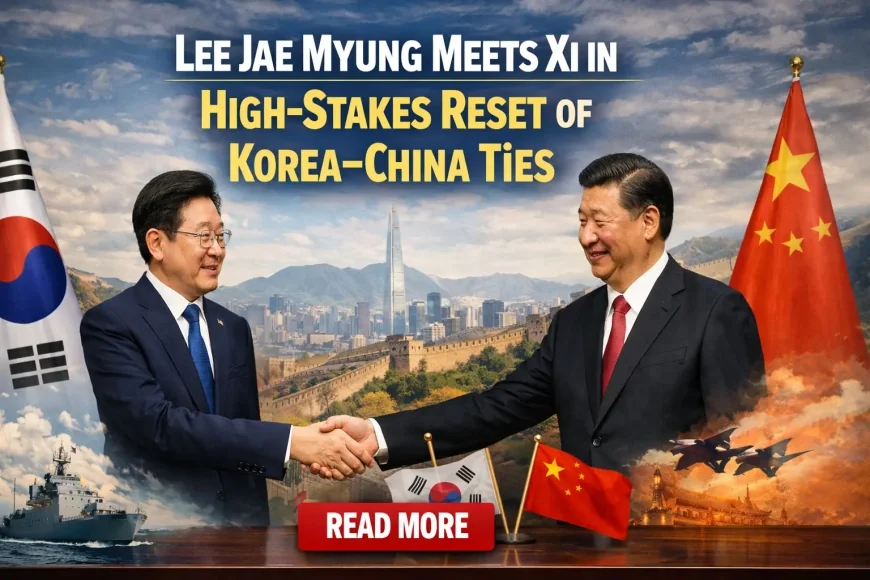
South Korean President Lee Jae-myung is set to meet with Chinese leader Xi Jinping to mend strained relations with his country's largest trading partner.
Regional security and an unofficial ban imposed by Beijing on Korean pop culture are also on the agenda for Monday's meeting. This is their second summit since November, when Xi visited South Korea.
China is a crucial economic partner, so experts say Lee wants assurances that China will not weaponize this relationship despite political tensions in the region.
In recent weeks, a diplomatic dispute between China and Japan over Beijing's claims to self-governing Taiwan has put Seoul, a major regional power, in a difficult position.
Beijing has escalated its rhetoric against Japan after its Prime Minister Sanae Takaichi suggested in parliament that Tokyo could respond with its self-defense forces in the event of a Chinese attack on Taiwan.
Therefore, Lee's visit to Beijing at this time is a significant move. Like Japan, South Korea is an ally of the United States, which supports Taiwan and supplies it with weapons for its defense.
Lee, who arrived in Beijing on Sunday, will attend a banquet hosted by Xi on Monday. He will then meet with Chinese Premier Li Qiang and the chairman of the parliament, Zhao Leji, before traveling to Shanghai.
Addressing Korean residents in Beijing, Lee said his visit would "serve as a new starting point to fill the gaps in Korea-China relations, normalize them, and elevate them to a new level."
This is the first visit by a South Korean leader since 2019. Relations deteriorated during the term of Lee's predecessor, former President Yoon Suk-yeol, who faced impeachment and was highly critical of China.
On the other hand, Xi's eagerness to meet with Lee indicates how much pressure he feels to find a regional ally, Park Seung-chan, a professor of Chinese studies at Yongin University. “China may be speaking in vague terms, but its demand is clear: side with China and condemn Japan.”
Mr. Park said that Beijing is exploiting the two countries' shared history of fighting against Japan during the 20th century. Lee is expected to hold a memorial service in Shanghai for activists who fought for Korea's independence from Japan. Mr. Park added that, while Korea still shows "full respect for China," it "wants to strengthen its relations with both Japan and China."
Software Services
 |
Start your own gaming platform for just $3,000 |
Seoul has long maintained a delicate diplomatic balance between Beijing and Tokyo. Lee is reportedly planning to visit Japan later this month to meet with Takaiichi. And on Friday, South Korea's national security director, Wi Sung-lac, told reporters that the country "respects the One China policy"—the diplomatic recognition that Beijing is the sole legitimate government of China.
Wi told reporters that security on the Korean Peninsula would also be part of the discussions with China.
Lee has attempted to engage diplomatically with North Korea, but so far with little progress. He needs Chinese cooperation to pressure North Korea's Kim Jong Un to abandon nuclear weapons. Aside from Russia, Beijing is the dictator's biggest economic and diplomatic supporter.
“China is a very important cooperative partner in moving toward peace and unification on the Korean Peninsula,” Lee said on Sunday.
Earlier in the day, Seoul's military said that Pyongyang had fired ballistic missiles off its east coast. And on Monday, North Korea's state news agency said the country had tested hypersonic missiles to assess its capabilities following recent developments—a reference to the US indictment of Venezuelan President Nicolás Maduro over the weekend.
It remains unclear how much pressure Lee will be able to exert on China regarding the North Korean issue. In September, Xi pledged to strengthen Beijing's "traditional friendship" with Pyongyang.
And Seoul and Beijing are not natural allies.
US troops have been stationed in South Korea for decades in case of a North Korean attack, and last year the two sides agreed to cooperate on building nuclear-powered submarines. This announcement drew a warning from China.
There are other troubling issues as well, such as China's unofficial ban on South Korean music and dramas, which has been in place for a decade. K-pop and K-dramas are either unavailable or difficult to access on Chinese media platforms.
While China has never acknowledged the ban on Korean artists, it is believed to be in retaliation for South Korea's 2016 decision to deploy a US anti-missile system, which China views as a threat to its military operations in the region.
Persuading Beijing to lift these restrictions is said to be high on Lee's agenda. China is a huge market for Korean entertainment, which is already very successful worldwide.
Lee will also try to stop the construction of maritime structures being built by China in waters between the two countries.Beijing says these structures are fishing equipment, but they have raised security concerns in Seoul.
Thank you for reading this content.
Thank you for reading this content.
What's Your Reaction?
 Like
0
Like
0
 Dislike
0
Dislike
0
 Love
0
Love
0
 Funny
0
Funny
0
 Angry
0
Angry
0
 Sad
0
Sad
0
 Wow
0
Wow
0