
































Meta on Trial: Zuckerberg Defends Against Addiction Claims
Mark Zuckerberg faces explosive claims in the Meta addiction trial as internal teen usage research surfaces in a landmark social media lawsuit.

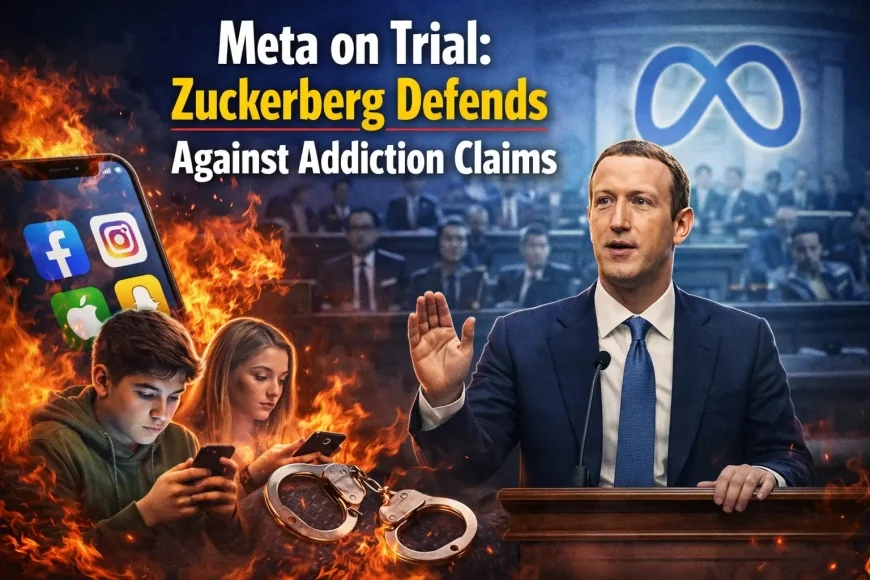
Mark Zuckerberg, the boss of Meta Platforms, which owns Instagram, faced a difficult time defending his company in court on Wednesday against claims that the company targets young users after being presented with several internal documents.
He said lawyers were "misrepresenting" communications presented as part of a landmark trial in Los Angeles over whether social media platforms like Instagram are addictive for children.
This was Zuckerberg's first appearance before a jury after years of growing opposition to Meta, which also owns WhatsApp and Facebook.
Google's YouTube is also a defendant in the trial and is being closely watched for its impact on thousands of similar cases.
TikTok and Snapchat, also named in the case, settled shortly before the trial began. The terms of the settlement were not disclosed.
Meta repeatedly stated that the company had taken action to protect young users and restricted access to users under the age of 13.
But in court, Mark Lanier, the lawyer representing the lead plaintiff in the case—known by his initials K.G.M.—repeatedly presented internal emails, messages, and research showing Zuckerberg and other Meta employees discussing the use of Instagram and Facebook by teenagers and younger.

A 2019 email sent to Zuckerberg and three top Meta executives questioned the company's "unenforced" age limits.
According to an email from Nick Clegg, who served as Meta's head of global affairs for several years after the former Liberal Democrat MP served as UK Deputy Prime Minister.
Lanier asked Zuckerberg about a 2019 research report by an outside company on Instagram's behalf, which found that teenagers who use the platform "feel connected to it, regardless of how it makes them feel," and that teen users had "an addictive story" about their Instagram use.
The report stated, "It can make them feel good, it can make them feel bad, they wish they spent less time on it."
Zuckerberg explained that this research was not conducted within Meta.
When Meta's lawyer, Paul Schmidt, questioned Zuckerberg about the same report, he said that it also mentioned "positive" aspects of Instagram use that had emerged from the research.
Schmidt described the report as part of Meta's ongoing efforts to research how its platform is used and continuously improve it.
Software Services

In another 2018 presentation, the firm discussed successfully retaining "tweens" on the platform, despite claiming such users were not permitted.
Zuckerberg said he had "always" regretted not making faster progress in identifying users under 13, but believed the company had reached "the right place over time."
He stated that teen users accounted for "less than 1%" of the company's ad revenue and accused Lanier of taking the tween document out of context.
Zuckerberg said his company had "multiple conversations" about creating versions of its products that children under 13 could use "in a regulated manner."
He pointed to his company's Messenger Kids service, which he said is "not very popular" but that he uses it "with his kids." Zuckerberg and his wife, Priscilla Chan, have three children.
Zuckerberg continued, "You're misunderstanding me." "I'm not surprised people were studying this internally."
Lanier also asked Zuckerberg about efforts to persuade teenagers to use the platform.

He showed Zuckerberg's email, as well as other internal messages, in which employees explicitly discussed "teen usage" and ways to increase it.
In a 2015 email, Zuckerberg told a group of executives that his goals for the year included "a 12% increase in time" and "reversing the teen trend."
A separate 2017 email from an executive stated that "Mark has decided that teenagers are the company's biggest priority."
Zuckerberg said that "earlier in the company," he had given executives time-boosting goals, but stressed that the company no longer operates that way.
In response to Schmidt's questions, Zuckerberg explained that if Meta had focused solely on metrics like time spent on its platform, it would not have survived for so many years.
Zuckerberg said that he has worked for years to fix "problematic use" of platforms like Instagram "because it's the right thing to do."
Schmidt mentioned Instagram tools released in 2018 that allow Instagram users to set daily usage limits, time alerts, and turn off notifications at night.

Lanier later pointed to an internal meta document that showed teenagers rarely used these tools.
Grieving parents were among those watching the proceedings in the courtroom, although only a few were allowed to sit.
More parents and family members gathered outside the courthouse to show their support for those who have seen their children suffer from the negative effects of social media use and addiction.
Lori Schott was one such parent. She wore a large badge bearing a photo of her daughter, Annalee Schott, who committed suicide at age 18.
"These platforms can change," Schott said outside court. "It won't take much to change algorithmic content so that children don't commit suicide. Is that so difficult, Mr. Zuckerberg?"
The trial is expected to last several weeks. It will include testimony from former Meta employees who have since spoken out about the company's practices.
YouTube boss Neal Mohan was also expected to appear, but he is no longer being called to testify.
During questioning last week, Instagram head Adam Mosseri challenged the idea of social media addiction, saying that even using Instagram for 16 hours a day doesn't lead to addiction.
Read Also

In his testimony, Zuckerberg said that if something is valuable, "people use it more."
Lanier said that people who are addicted to something also increase their use.
Zuckerberg replied, "I don't know what to say about that." "I think that might be true, but I don't know if it applies here."
This case is one of thousands of similar cases brought by families, state prosecutors, and school districts currently pending in US courts.
These cases accuse Meta and other social media platforms, including TikTok, Snapchat, and YouTube, of operating in an addictive manner, ultimately harming many children.
In one such case, 29 state attorneys general are pressuring a California federal court to require the platform to make several changes immediately before any trial, including forcing Meta to delete all accounts of users under the age of 13.
Many countries are moving to restrict social media use by young people. Australia banned social media accounts for those under the age of 16 late last year.
The UK, Denmark, France, and Spain are also considering similar measures.
Thank you for reading this content.
Thank you for reading this content.
What's Your Reaction?
 Like
0
Like
0
 Dislike
0
Dislike
0
 Love
0
Love
0
 Funny
0
Funny
0
 Angry
0
Angry
0
 Sad
0
Sad
0
 Wow
0
Wow
0