



























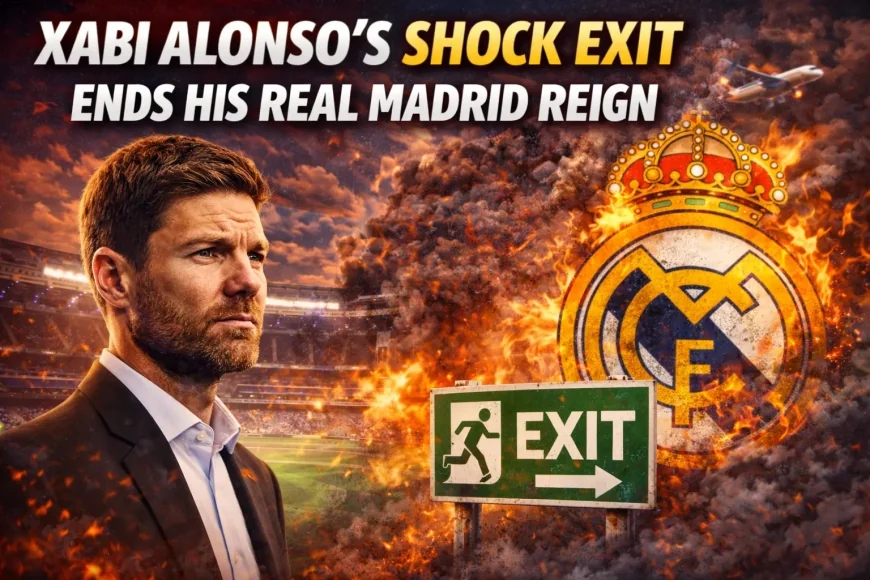
Xabi Alonso’s Shock Exit Ends His Real Madrid Reign
Xabi Alonso leaves Real Madrid after just 7 months, amid player unrest and tactical clashes. Madrid’s club culture proved too rigid for the young manager.

Kylian Mbappé was gesturing for his teammates to leave the pitch. Xabi Alonso was telling them to stay. Mbappé persisted. And eventually, Xabi relented and did what his star player wanted. Barcelona received no guard of honor after winning the Spanish Super Cup on Sunday.
To many, it felt like a lack of sportsmanship, something never before associated with Xabi Alonso. It also revealed something else: that the team, not the manager, was in control.
And after a final that was so tight, decided by a deflection, you can almost imagine Xabi thinking: enough is enough.
But this wasn't a resignation. And it wasn't planned. Xabi Alonso didn't expect to be leaving his post as Real Madrid boss – just seven and a half months after being appointed. Not yet, anyway.
In the official statement, Real Madrid described the departure as "by mutual consent," but it was a resignation that was ultimately inevitable.
After several disagreements with their manager over tactics and approach in recent months, a board meeting was held on Monday around 4:30 pm Spanish time with only one item on the agenda – Xabi Alonso's departure.
The explanations given to him and his staff were, to say the least, vague.
'He hadn't been able to implement the football that had made him so successful at Bayer Leverkusen'. 'The team's physical condition wasn't ideal'. 'The players hadn't improved'. 'It didn't look like they were playing for him'.
A list of defeats was cited: against Paris Saint-Germain in the Club World Cup semi-final, against Atlético Madrid in La Liga (5-2), and others.
And yet Real Madrid are in the top eight of the Champions League group stage, the competition that defines them. They have reached the next round of the Copa del Rey and are four points behind Barcelona halfway through La Liga, having beaten the Catalan team when they met in October.
More than a crisis, it was confirmation that Florentino Pérez had never truly believed in his manager.
Software Services
 |
Turn your casino idea into a live platform — start your journey today |
Xabi Alonso's name had been suggested to him and agreed upon as the club's new boss, but without conviction. Even at his previous club, Bayer Leverkusen, not everyone believed in Xabi from day one.
Results came, and the team rallied behind him. In Madrid, despite good results, that never happened. From the start, Xabi felt isolated.
Starting a career as manager at Real Madrid is one of the most difficult challenges in football. Nobody says no to Madrid, not even those who understand how difficult it is to transform a culture built on individual talent into a modern collective team where everyone presses and everyone defends.
A manager is strongest when he arrives, but Madrid undermined his authority from the start.
He wanted to start his tenure after the Club World Cup, not before. This tournament was played after a long season, with players thinking about holidays and some knowing they wouldn't be there the following year. He wasn't even allowed to discuss this.
The signings didn't help much either: Franco Mastantuono, who some sections of the media had touted as the anti-Lamine Yamal, made little impact.

Vinícius Júnior's crisis marked the beginning of the end; his form dropped, and he blamed the new manager, then he openly protested his substitution in El Clásico, and then apologized to everyone except the manager.
Contract negotiations were put on hold to see what would happen with Xabi. Injuries decimated the defense, while the club ignored his request for a midfielder (he wanted Martín Zubimendi).
There was no strong personality to bind the group together. Even Federico Valverde was more concerned with where he played than with the team.
Mbappé was chasing records, not always doing what was needed to recover from his recent injury; he was playing to equal Cristiano Ronaldo's 59 goals in a calendar year.
Xabi never managed to convince the players that his way was the right way. And without that, he couldn't implement the high press, the tempo, the positional football that defined his Leverkusen team.

So what now?
He has to decide whether it's best for him to rest for a while. Those who know him believe that leaving, even if he doesn't want to, would provide some relief. It simply didn't work out.
But the message from Europe's biggest clubs is clear: many would be happy to have him next season if circumstances allow.
Real Madrid is once again being portrayed as an outlier – a club that operates differently, limits its managers, and, with the help of a loyal media, quietly lays the groundwork for a dismissal months before it happens.
Next in line is Álvaro Arbeloa, the Castilla coach. A club man. But if a legend like Xabi Alonso couldn't change the culture, Arbeloa faces an almost impossible task.
If this season ends without any trophies, the belief of Europe's big clubs will be further reinforced. If, in one of football's familiar paradoxes, Real Madrid wins a trophy, we will arrive at the same conclusion we always do.
Thank you for reading this content.
Thank you for reading this content.
What's Your Reaction?
 Like
0
Like
0
 Dislike
0
Dislike
0
 Love
0
Love
0
 Funny
0
Funny
0
 Angry
0
Angry
0
 Sad
0
Sad
0
 Wow
0
Wow
0