



























Canada, US & Mexico: World Cup Group Outlook
Canada, Mexico, and the United States discovered their World Cup 2026 group opponents in a high-profile draw featuring sports legends like Tom Brady and Shaquille O’Neal.

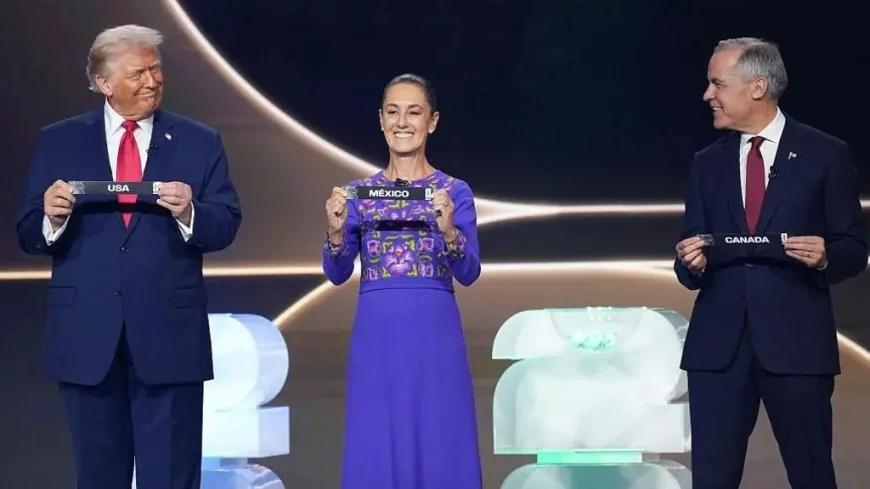
Tom Brady, Shaquille O'Neal, Aaron Judge, and Wayne Gretzky were tasked with drawing the names for the tournament's group stage, which accounts for most of the games in this major global sporting event.
As part of the draw, this group of North American sporting legends revealed which teams the three co-hosts would have to overcome if they reached the knockout stage, resulting in a highly competitive draw for each.
This will be the largest World Cup ever, as it is the first to feature 48 teams. When the tournament was first hosted in the United States in 1994, there were only 24 countries, but the number was expanded to 32 in the next edition in France in 1998.
With so many teams, the draw and the process behind it, held in Washington, DC on Friday, revealed a multitude of details and changes. Even the four aforementioned draw assistants, and hosts Rio Ferdinand and Samantha Johnson, had to pause several times to take it all in.
The outcome was easy to see from the individual teams' perspectives, and from the hosts' perspective, the draw format offered a slight advantage, even greater than the advantage they already had from playing at home.
As hosts, Canada, Mexico, and the United States also received the automatic privilege of being in Pot One – along with the competition's strongest teams – meaning their path to the knockouts could potentially be easier.
So, their main consideration was which teams from Pot Two – the next highest-ranked teams – would join the hosts' group, as the teams in this pot would likely pose the toughest challenge.
All three will be happy to eliminate Croatia and Morocco from Pot 2 and Norway from Pot 3, who performed well in qualifying but still have some tough games ahead.
In Group A, Mexico faces South Korea, whose star player and captain, Son Heung-min, recently joined Major League Soccer's Los Angeles FC, increasing his knowledge of the region ahead of the World Cup.
South Korea remained unbeaten in Asian qualifying, conceding just eight goals in 16 games. This was perhaps the toughest draw for any host nation.
Mexico has been the best performer among the hosts in recent regional competitive play, winning the Nations League in March and the Gold Cup in July.
However, since then, it has won only one of the friendly matches played until late 2025, as coach Javier Aguirre tries to figure out what his World Cup roster will look like.
As hosts, Canada, Mexico, and the United States also had the automatic privilege of being in Pot One – with the competition's strongest teams – meaning their path to the knockouts could be easier.
So, their main concern was which teams from Pot Two – the next highest-ranked teams – would join the hosts' group, as the teams in this pot would likely pose the toughest challenge.
All three will be happy to avoid Croatia and Morocco from Pot Two and Norway from Pot Three, who all impressed in qualifying, but still have some tough games to deal with.
Mexico faces a tough match in Group A against South Korea, whose star player and captain, Son Heung-min, recently joined Major League Soccer's Los Angeles FC, increasing their familiarity with the region ahead of the World Cup.
South Korea remained unbeaten in Asian qualifying, conceding just eight goals in 16 games. This was perhaps the toughest draw for any host nation. Mexico has been the best-performing host in recent regional competitions, winning the Nations League in March and the Gold Cup in July.
However, since then, it has won just one of the friendlies played in late 2025, as coach Javier Aguirre tries to figure out what his World Cup roster will look like.
His team will open the tournament at the iconic Estadio Azteca in Mexico City on 11 June, where it faces South Africa, which edged out Nigeria in a close-run African qualifying stage.
Group A will be completed by the winner of a UEFA qualifying play-off in March, when one of Denmark, North Macedonia, the Czech Republic or the Republic of Ireland will join them.
Canada will also face a team that was unbeaten and boasted a solid-looking defence in qualifying, Switzerland. It is joined in Group B by 2018 World Cup host Qatar, but another potentially tough test could come from the winner of another UEFA qualifying contingent, which contains Italy, a four-time World Cup champion.
Italy will be expected to navigate a European play-off that includes Northern Ireland, Wales, and Bosnia and Herzegovina, having been beaten to automatic qualification by that impressive Norway team, and it would be a tough opponent for the Jesse Marsch-coached Canadians.
Though their prospective opponents would disagree, the United States has the easiest draw of the three hosts. As a result, there will be pressure on the team, coached by Argentine Mauricio Pochettino, to reach the knockout rounds.
They are joined in Group D by the lowest-ranked team from pot two, Australia. The Socceroos participate in the Asian qualifying section, where they lost just once in the 10 games of the last round of qualifying, but only won five, reaching the World Cup as second in its group behind Japan. The US defeated Australia in a friendly match earlier in the year, just as they did Paraguay, who joined this group from pot three. Promising signs.
As is the case with the other hosts' groups, there is uncertainty in terms of the completion of Group D. The final team will come from another UEFA play-off winner, this time from the section involving Turkey, Romania, Slovakia, and Kosovo, but the US will fancy their chances against anyone from this European collection.
Host nations remaining in a World Cup beyond the group stage always makes for a better tournament, and each of Canada, Mexico, and the US will be confident of such progress thanks to this draw.
What's Your Reaction?
 Like
1
Like
1
 Dislike
0
Dislike
0
 Love
0
Love
0
 Funny
0
Funny
0
 Angry
0
Angry
0
 Sad
0
Sad
0
 Wow
0
Wow
0