


























Pentagon Bombshell: US Navy Chief Abruptly Steps Down
US Navy shake-up as John Phelan exits suddenly. Explore key Pentagon leadership changes and rising tensions in the Strait of Hormuz crisis.

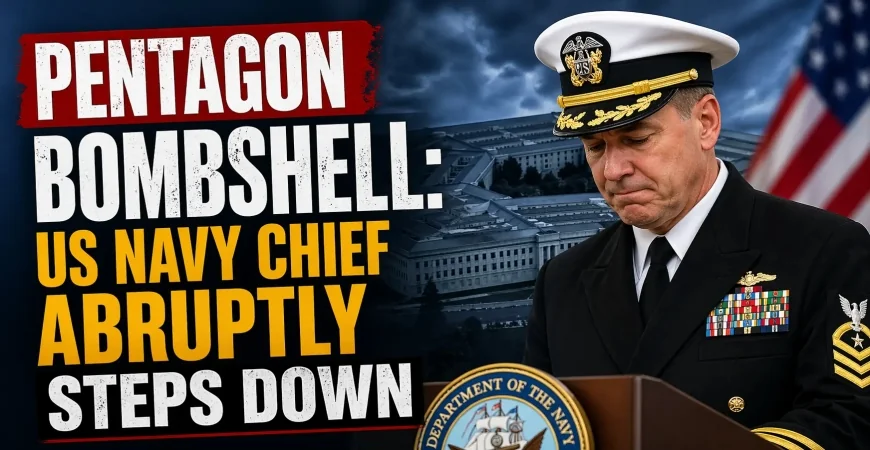
The Pentagon announced on Wednesday that US Navy Secretary John Fallon is leaving the Trump administration.
Pentagon spokesperson Sean Parnell stated in a social media post that his departure would be "effective immediately."
Parnell further added that the Navy's Under Secretary, Hung Cao, will serve as Acting Secretary.
Fallon is the latest high-ranking military leader to leave the administration in recent months. His departure comes amidst the US-Iran conflict and the ongoing US blockade of the Strait of Hormuz.
Parnell wrote, "On behalf of the Secretary of Defense and the Deputy Secretary of Defense, we are grateful to Secretary Fallon for his service to the Department and the US Navy." "We wish him well in his future endeavors."
The Navy did not provide a reason for Fallon's departure.
This comes just weeks after US Secretary of Defense Pete Hegseth asked Army Chief of Staff Randy George to step down from his post.
Two other Army officers—General David Hodne and Major General William Green—were also recently removed from their positions.
Since arriving at the Pentagon, Hegseth has dismissed more than a dozen senior military officials, including the Chief of Naval Operations and the Air Force Deputy Chief of Staff.
The role of the Secretary is primarily administrative, involving the formulation of policies, recruitment, the training and equipping of the Navy, as well as the oversight of budgets and logistics—such as the construction and maintenance of naval vessels and facilities.
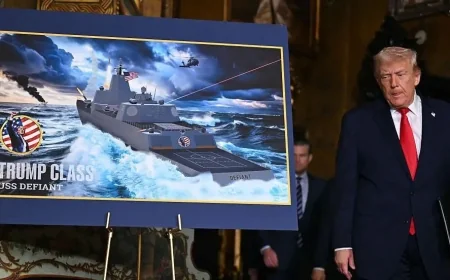
Fallon—a civilian who had not previously served in the military—was sworn in as Secretary of the Navy in March 2025, following his nomination by President Donald Trump in 2024. The businessman was a major donor to Trump's campaign. The two appeared together at Mar-a-Lago last December, when Trump announced that the U.S. Navy would commission a new series of "battleships"—heavily armed vessels that would be named after him—as part of a revamped "Golden Fleet," a concept that Phalen had supported.
Andrew Peek, a former Deputy Assistant Secretary of State, noted that the President was clear about his desire to expand the nation's merchant and civilian fleets.
"Ultimately, someone had to become the scapegoat for the lack of action on that front. I’d bet that accounts for about 30% of it," Peek said. "As for the remaining 70%—MAGA supporters know the person replacing Phalen very well. I’m quite certain this is a straightforward personnel change, in which he is being replaced by someone the President likes more and trusts more," he added.
 |
Start your own gaming platform for just $3,000 |
Cao, Phalen’s replacement, became Under Secretary in October 2025 and has served in the Navy for 25 years.
He ran for the U.S. Senate from Virginia in 2024 but was unsuccessful. In that election, he had Trump's endorsement and faced off against incumbent Democratic Senator Tim Kaine. During a campaign debate, he criticized Diversity, Equity, and Inclusion (DEI) initiatives within the military.
Speaking on the subject of Navy recruitment during the debate, Cao stated: "We need 'alpha males' and 'alpha females' who will rip out their guts and eat them, and then ask for more. Those are the young men and women who will win wars," the AP reported. This change in the Navy's leadership comes at a time when Trump has stated that, despite the ceasefire, the U.S. blockade of Iranian ports will continue. Clashes persist in the Strait of Hormuz—a critically important global maritime route through which oil is supplied worldwide. Meanwhile, Iran has announced that it has "seized" two vessels in this strait.
White House Press Secretary Karoline Leavitt stated that the President is "satisfied" with the current U.S. naval blockade of Iranian ports, and that he "fully understands that Iran is currently in a very weak position."
Mohammad Bagher Ghalibaf, Iran's chief negotiator in talks with the U.S., said on Wednesday that reopening the Strait of Hormuz is "not possible" due to "flagrant violations of the ceasefire" by the U.S. and Israel.
Thank you for reading this content.
What's Your Reaction?
 Like
0
Like
0
 Dislike
0
Dislike
0
 Love
0
Love
0
 Funny
0
Funny
0
 Angry
0
Angry
0
 Sad
0
Sad
0
 Wow
0
Wow
0