



















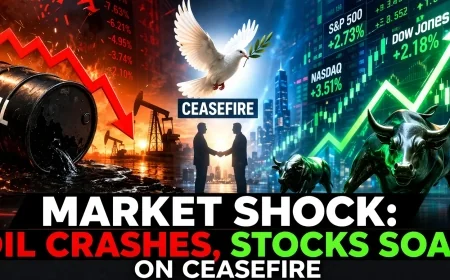






Market Shock: Oil Crashes, Stocks Soar on Ceasefire
A US Iran truce triggers a sharp oil price crash and global stock rally. Markets react as Strait of Hormuz reopens, easing energy supply fears.

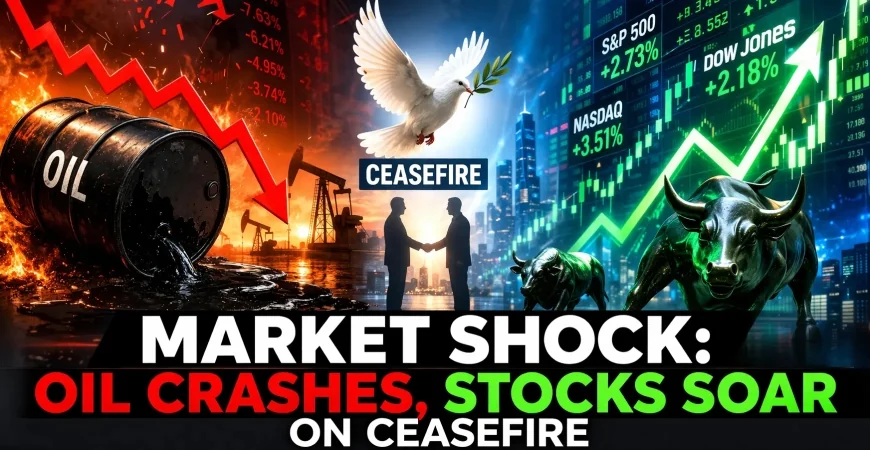
Following an agreement between the US and Iran on a conditional two-week ceasefire deal, global oil prices have plummeted, and stock markets have surged. This deal includes the reopening of key waterways, such as the Strait of Hormuz.
The price of benchmark Brent crude fell by approximately 13% to $94.80 (£70.73) per barrel, while the price of US-traded oil dropped by more than 15% to $95.75.
However, oil prices remain higher than the levels seen before the conflict began on February 28. At that time, it was trading at around $70 per barrel.
Energy prices had spiked because, in response to airstrikes by the US and Israel, Iran had threatened to attack vessels attempting to use the strait; this subsequently severely disrupted oil and gas supplies from the Middle East.
Read Also
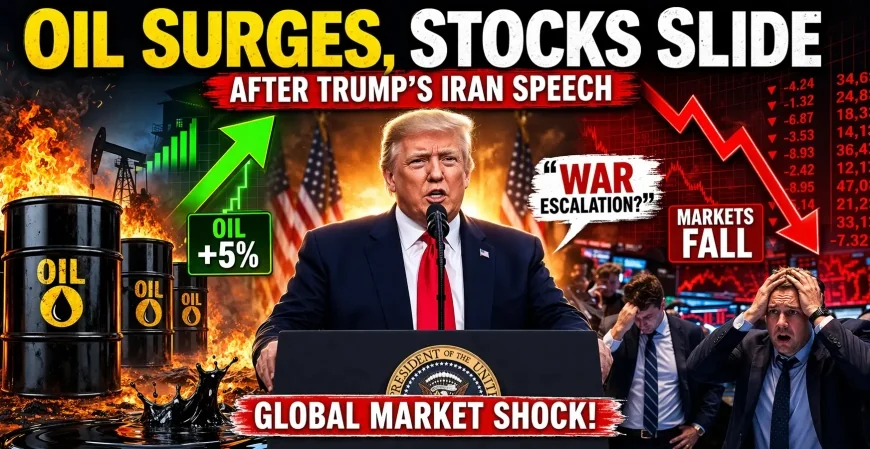
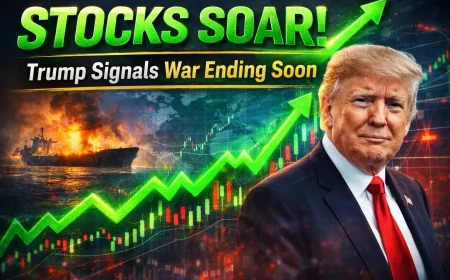
Following a sharp rally in Asia, European stock markets also opened with gains. London's FTSE 100 share index climbed 2.53% in early trading. In France, the CAC rose by 4%, while Germany's DAX climbed nearly 5%.
Japan's Nikkei 225 rose 5%, while South Korea's Kospi climbed approximately 6%. Hong Kong's Hang Seng was up 2.8%, while Australia's ASX 200 rose 2.7%.
US stock market futures also signaled that Wall Street was poised to open with gains.
A futures contract is an agreement to purchase an asset at a later date at a predetermined price. In the case of US stock futures, they can indicate the direction of the market even before the market officially opens. In a social media post on Tuesday evening, Trump stated: "I agree to halt bombing and attacks on Iran for a period of two weeks... provided that the Islamic Republic of Iran agrees to fully, immediately, and safely open the Strait of Hormuz."
He had set a deadline of 20:00 EDT on Tuesday (00:00 GMT on Wednesday), threatening that if no deal were reached, "an entire civilization will end tonight." Iran's Foreign Minister, Abbas Araqchi, stated on social media that Tehran would agree to a ceasefire only "if attacks on Iran are halted," adding that a safe passage through the Strait of Hormuz would then "become possible."
Software Services

Xavier Smith of the market research firm AlphaSense noted that, despite his threats, Trump would likely remain cautious about further escalating the conflict to the point where energy prices begin to "skyrocket."
Research Director Smith remarked that this could result in "self-inflicted economic injury"—a risk few would be willing to take, particularly at a time when Trump's leadership is already under pressure due to his approval ratings.
Saul Kavonic, an analyst at the financial services firm MST Marquee, suggested that additional oil tankers currently stranded near the strait would be able to traverse the waterway during the ceasefire, potentially offering some relief to markets in the coming weeks.
Despite the ongoing conflict, some vessels have continued to pass through the Strait of Hormuz, although their numbers have remained significantly lower than usual.
Asian nations—including India, Malaysia, and the Philippines—have held negotiations in recent weeks to secure safe passage for their vessels.

China has also confirmed that several of its ships have successfully transited the strait since the onset of the conflict. Meanwhile, a Maltese-flagged container ship owned by the French company CMA CGM passed through this shipping lane; the media organization BFM TV—which is owned by the same shipping firm—confirmed this on Friday.
Additionally, a Japanese vessel carrying natural gas also safely exited the strait, a fact confirmed by the shipping giant MOL.
Cavonic stated that even if a ceasefire were to take effect, it remains unlikely that energy production in the Middle East would fully resume until there is complete confidence in a lasting peace agreement.
He further noted that, due to the damage sustained by energy infrastructure in the region, it could take several months for production to restart.
Thank you for reading this content.
Thank you for reading this content.
What's Your Reaction?
 Like
1
Like
1
 Dislike
0
Dislike
0
 Love
0
Love
0
 Funny
0
Funny
0
 Angry
0
Angry
0
 Sad
0
Sad
0
 Wow
0
Wow
0