


























Trump Halts Iran Strike After Urgent Plea From Gulf Leaders
Trump delays Iran strike as nuclear tensions rise and Gulf states push for peace talks amid fears of a wider Middle East conflict.

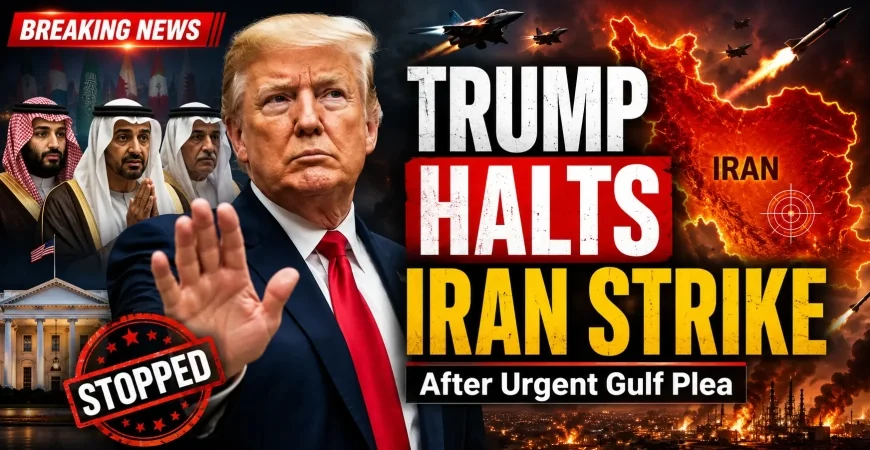
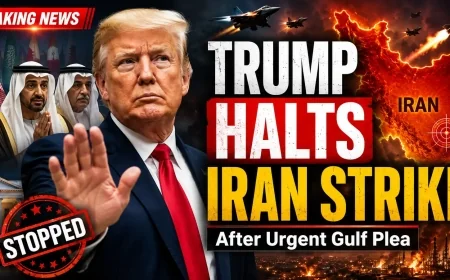
US President Donald Trump has stated that, at the behest of Gulf nations, he is postponing a planned military strike against Iran scheduled for Tuesday, as "serious negotiations are now underway."
He added that he has been assured that a deal will be reached that is "fully acceptable" to the US, and further asserted that "Iran will not possess any nuclear weapons!"
However, he issued a warning that if an acceptable deal is not reached, the US "will be ready to strike Iran with full force, on a massive scale, at any moment."
A senior Iranian military commander warned the US not to "make any further strategic errors or miscalculations."
Trump's latest announcement regarding Iran comes at a time when his approval ratings are slipping, and polls indicate growing public discontent within the country regarding the prospect of war.
Polls also reveal that only 37% of voters approve of Trump's performance as president. These surveys underscore the significant challenge facing the Republican Party in the upcoming midterm elections—a period marked by rising public frustration over the issue of war, as well as Trump's stance on matters such as the economy and immigration.
On February 28, Israeli and US forces launched large-scale airstrikes against Iran; in retaliation, Tehran fired drones and missiles at Israeli and US bases located in the Gulf region.
A major factor at play here is the apprehension among Arab nations in the Gulf regarding how Iran might respond to any further military action initiated by the US. It is believed that Iran possesses a large arsenal of drones and missiles, which it could utilize to launch large-scale attacks against its neighbors—targeting their airports, petrochemical facilities, and even critical desalination plants that supply drinking water—particularly at a time when summer temperatures are soaring across the Gulf region.
Speaking to reporters later, Trump described this as "a very positive development," though he added, "We will see if it leads to anything."
He stated: "There have been times when we felt we were quite close to reaching a deal, but it didn't materialize. This time, however, the situation feels a bit different."
Trump remarked that there appears to be a "very good possibility" of reaching an agreement with Iran, adding: "If we can achieve this without having to bomb them, I would be very pleased."
The ceasefire agreed upon in April was intended to create a conducive atmosphere for negotiations; and despite sporadic incidents of gunfire, the truce has largely been observed. Iran has also maintained its control over the Strait of Hormuz—effectively blockading the vital waterway through which approximately 20% of the world's oil and liquefied natural gas passes.
Iran has asserted that this measure was taken in retaliation for attacks by the United States and Israel—a move that has caused global oil prices to skyrocket.
 |
Start your own gaming platform for just $3,000 |
Conversely, the United States is imposing a blockade on Iranian ports in an effort to exert pressure on Tehran and compel it to accede to U.S. terms.
Late Monday night, Iran's Tasnim News Agency published a statement containing remarks it attributed to Supreme Leader Mojtaba Khamenei. It warned that new fronts would be opened in areas where the enemy possesses very little experience and would be in an extremely vulnerable position.
It appears that Tasnim has merely republished Khamenei's statements from March 12. Some Iranian media outlets have begun republishing his previous written messages.
Earlier on Monday, Iran stated that it had responded to the latest US proposal and that negotiations with Washington are continuing through Pakistani intermediaries.
Iranian media had previously reported that the US had failed to offer Tehran any concrete concessions.
On Sunday, Trump warned that "the clock is ticking fast for Iran, and they must take action as soon as possible—very quickly—otherwise nothing will remain of them."
A few days earlier, rejecting Tehran's demands and labeling them "completely unacceptable," the US President had stated that the ceasefire was "on life support."
Iranian Foreign Ministry spokesperson Esmail Baghaei emphasized that their demands were "responsible" and "generous."
According to Iran's semi-official news agency, Tasnim, Iran's demands included an immediate cessation of hostilities on all fronts—a reference to Israel's ongoing attacks against the Iran-backed Hezbollah in Lebanon—as well as an end to the US naval blockade of Iranian ports and guarantees against any future attacks on Iran.
According to reports, these demands also included a call for compensation for damages incurred during the conflict, as well as an assertion of Iran's sovereignty over the Strait of Hormuz.
Iran's semi-official news agency, Fars, reported on Sunday that Washington has put forward five conditions in response to Tehran's proposal. According to reports, these conditions included the demand that Iran keep only one nuclear site operational and hand over its stockpile of highly enriched uranium to the United States. On Friday, Trump indicated that he would accept Iran suspending its nuclear program for 20 years.
The United States and its European allies claim that Iran is attempting to develop nuclear weapons through uranium enrichment. Tehran has repeatedly stated that its nuclear program is entirely for peaceful purposes.
Thank you for reading this content.
What's Your Reaction?
 Like
0
Like
0
 Dislike
0
Dislike
0
 Love
0
Love
0
 Funny
0
Funny
0
 Angry
0
Angry
0
 Sad
0
Sad
0
 Wow
0
Wow
0