





























Energy Bill Aid Shake-Up: Help Tied to Your Income
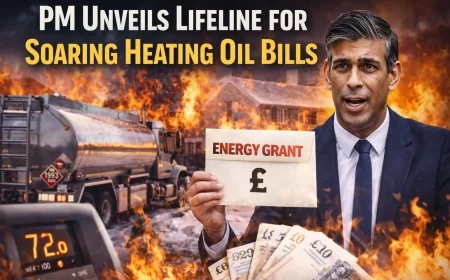
Energy bill relief may shift to household income as prices surge due to global oil shocks, with support likely delayed until autumn, Reeves signals.

Government assistance to help with energy bills—inflated due to the conflict in Iran—will be allocated based on household income, though she indicated that this aid might not become available until the autumn.
Wholesale oil and gas prices have surged significantly over the past month, as supplies from the Middle East have been severely disrupted. While household energy bills are expected to decrease between April and June under Ofgem’s price cap, they are likely to experience a sharp spike thereafter.
Rachel Reeves stated that it would be "premature" at this stage to specify exactly who would receive assistance; she added that while energy demand typically subsides during the summer months, it begins to rise again as autumn approaches.
However, she declined to promise any immediate relief for motorists, emphasizing the necessity of maintaining control over the public purse.
Last week, Reeves confirmed that any assistance provided for gas and electricity bills would be "targeted at those who need it most," rather than being distributed as the kind of universal support introduced by Liz Truss’s government in 2022.

"I want to learn from the mistakes of the past; when Russia invaded Ukraine, the wealthiest and most financially secure third of households received more than a third of the total aid package. That simply makes no sense."
Reeves acknowledged that gas consumption would inevitably rise during the autumn—precisely when Ofgem’s current price cap for households in England, Scotland, and Wales is set to expire. The details of the next price cap have not yet been announced, but it is widely expected to see a substantial increase.
She noted, "From July to September, gas consumption—particularly among families and pensioners—is at its lowest point compared to the rest of the year, as these are the summer months." When asked whether this assistance could be extended beyond those who already receive government benefits, Reeves stated: "We are exploring ways in which we can provide support to people based on their household income."
However, the Shadow Chancellor declined to make any firm promises regarding cuts to fuel duty or VAT on petrol; she noted that she must exercise "considerable caution" when pledging to lower prices for the general public, as doing so could risk triggering future increases in inflation, interest rates, and taxes.
Software Services

She further added that the most effective way to lower prices for the public is for the current conflict to end and for the Strait of Hormuz to reopen. This strait is a critical maritime artery through which roughly one-fifth of the world's total oil and Liquefied Natural Gas (LNG) typically passes; however, since the outbreak of the conflict, this route has remained almost entirely closed. "That is why Keir Starmer was absolutely right not to drag us into a war we did not start, because the repercussions of such a conflict are felt right here by the people of our country," she said.
The Conservative Party has urged the government to remove VAT from household energy bills for the next three years in an effort to help alleviate the rising cost of living for the public.
Reform UK has also pledged that, should their party come to power, they would remove both VAT and green levies from household energy bills.
Read Also

The Liberal Democrats have stated that they would reduce household energy bills by restructuring the way new renewable energy projects are funded, thereby decoupling the link between gas prices and overall energy costs.
The Green Party has asserted that ministers must provide a guarantee that household energy bills will not rise in July, when the energy price cap is scheduled to be updated. These costs should be met by increasing taxes on capital gains and by further tightening the existing tax regime on the profits of energy companies.
Plaid Cymru has also demanded that households receive comprehensive and direct support whenever bills rise above the current price cap. The party also advocates for long-term investment in renewable energy to decouple electricity prices from gas prices.
The SNP argues that control over energy policy should rest with Holyrood, and asserts that the best way to lower energy bills in Scotland is to achieve independence.
Thank you for reading this content.
Thank you for reading this content.
What's Your Reaction?
 Like
0
Like
0
 Dislike
0
Dislike
0
 Love
0
Love
0
 Funny
0
Funny
0
 Angry
0
Angry
0
 Sad
0
Sad
0
 Wow
0
Wow
0