































$115 Oil Shock: Asia Markets Crash as War Escalates
Global markets reel as oil surge drives Asia market crash amid rising geopolitical tensions. Investors fear supply disruption and economic slowdown.

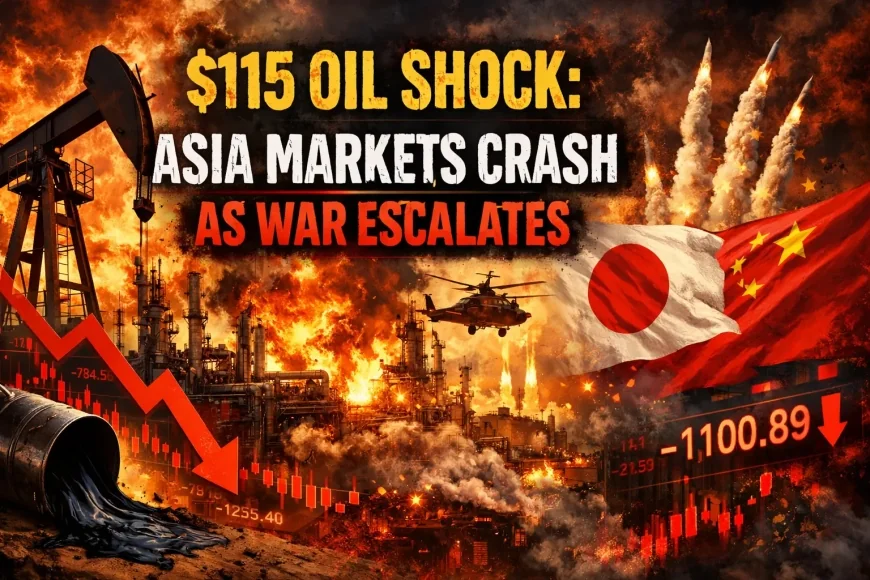
Global oil prices surged in Asia on Monday morning, while stock markets plummeted, as the conflict between the U.S., Israel, and Iran escalated.
Brent crude prices rose by more than 3% to climb above $115 (£86.77) per barrel, while U.S.-traded oil gained approximately 3.5% to reach $103. This places Brent on track for its largest-ever monthly gain.
Asian stock markets opened lower; Japan's Nikkei 225 fell 4.5%, and South Korea's Kospi dropped 4%.
This development followed the entry of Iran-backed Houthi rebels in Yemen into the conflict over the weekend, as they launched attacks on Israel, while Iran threatened to intensify retaliatory strikes against universities as well as the homes of U.S. and Israeli officials.
In an interview with the *Financial Times* on Sunday, U.S. President Donald Trump stated that he could "take Iran's oil" and potentially seize its key fuel hub, Kharg Island.
Read Also
When asked about Iran's defenses on the island, he remarked: "I don't think they have any defenses. We could take it very easily."
Trump drew a parallel between this potential move and the situation in Venezuela, where the U.S. plans to control the oil industry "indefinitely" following its efforts to oust then-President Nicolás Maduro in January.
Furthermore, over the weekend, the Speaker of Iran's parliament warned that his country's forces were "waiting for American troops," as an additional 3,500 U.S. soldiers arrived in the Middle East.
Global energy markets have been experiencing significant volatility since Iran threatened to attack vessels attempting to pass through the Strait of Hormuz in retaliation for U.S. and Israeli strikes. Approximately 20% of the world's oil and gas supply typically passes through this narrow waterway; however, it has now come to an almost complete standstill, driving up prices.
Sean Foley, an energy market expert at Macquarie University, stated that he expects oil prices to rise further until the conflict subsides.
Software Services

Foley noted that the Houthi attacks have heightened concerns that this armed group could disrupt energy shipments passing through the Bab al-Mandeb Strait, located near Yemen.
Foley added that a blockade of this waterway could impact an additional 10% of the global oil supply, thereby placing "immense pressure on global supply chains." Andrew Lipow of the consulting firm Lipow Oil Associates predicted that the price of Brent crude could reach $130 per barrel in the coming weeks, as threats to the global energy supply persist.
He remarked, "My greatest fear is that a widespread global economic recession could ensue... because consumers will be left with no disposable income, as they are spending an increasing amount on energy—and, furthermore, on food."
On February 27—just one day before the US and Israel launched an attack on Iran—the price of Brent crude stood at approximately $72 per barrel.
Thank you for reading this content.
Thank you for reading this content.
What's Your Reaction?
 Like
0
Like
0
 Dislike
0
Dislike
0
 Love
0
Love
0
 Funny
0
Funny
0
 Angry
0
Angry
0
 Sad
0
Sad
0
 Wow
0
Wow
0