




























Kharg Island Showdown: US Plan to Strike Iran’s Oil Lifeline
US plan to seize Kharg Island could trigger conflict. Explore key military risks, oil supply impact, and tensions in the Strait of Hormuz.

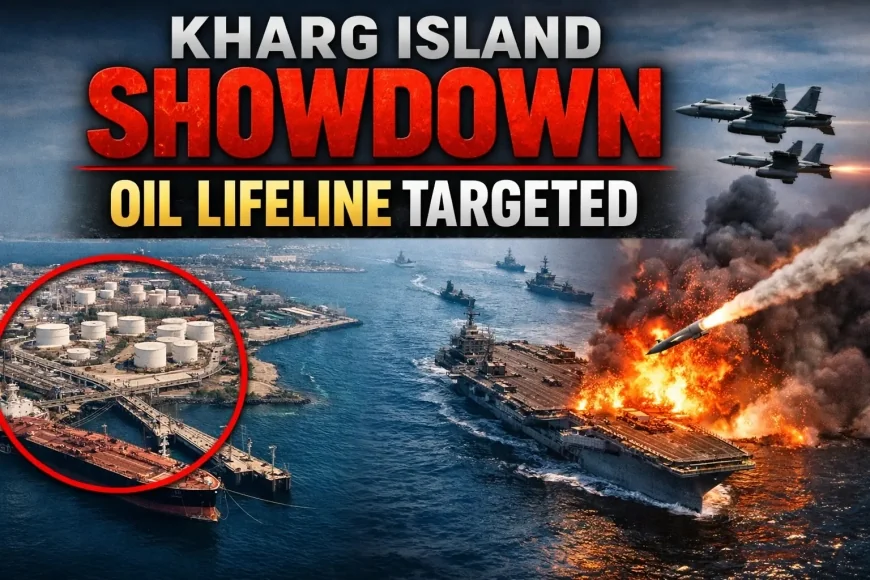
US President Donald Trump has signaled that he may send troops to seize Iran's main oil export terminal on Kharg Island in the northern Gulf. So, what is the rationale behind this? How would such an operation unfold, and what are the associated risks?
Kharg Island has long served as the primary hub for Iran's oil exports. Situated some distance off the coast, the island is surrounded by waters deep enough to accommodate the loading of tankers known as "Very Large Crude Carriers" (VLCCs)—vessels capable of carrying approximately two million barrels of oil. Nearly 90% of Iran's oil exports originate from Kharg Island.
During the Iran-Iraq War in the 1980s, the Iraqi Air Force subjected the island to repeated bombing raids. On March 13 of this year, the US struck 90 targets on the island, asserting that these were military installations. However, the US refrained from inflicting any damage upon the oil-related infrastructure.
Should the US decide to launch an assault on Kharg Island, it would likely be a temporary measure. The objective would be to exert pressure on Iran—compelling it to halt its oil exports, loosen its grip on the Strait of Hormuz (one of the world's busiest oil transit routes), and accede to Washington's demands.
Read Also
Given the Iranian regime's resolute intentions and intransigent stance, it remains difficult to predict how effective this strategy would ultimately prove to be.
Mohammad Bagher Ghalibaf, the Speaker of the Iranian Parliament, has issued a warning that should any US military forces attack his country, the Iranian military would "rain fire" upon them. It is believed that Iran has further bolstered its defensive capabilities on the island, including the deployment of surface-to-air missile systems. Iran has also accused the US of adopting a double standard. It argues that, on one hand, the US is proposing peace talks, while on the other, it is deploying its military forces to the very same region. These forces comprise approximately 5,000 US Marines and about 2,000 paratroopers from the 82nd Airborne Division.
Consequently, speculation has intensified that one or both of these contingents could be utilized to seize Kharg Island and bring it under their control.
Theoretically, paratroopers could execute an airborne assault—likely under the cover of darkness—to capture key installations on this small island. The island spans an area of merely 20 square kilometers (7.7 square miles).
US Marines would disembark from ships equipped with Osprey tilt-rotor aircraft and Landing Craft Air Cushion (LCAC) vessels. With the aid of these aircraft and craft, the Marines could easily execute amphibious landings on both land and water. However, first and foremost, these ships would face the formidable challenge of navigating the Strait of Hormuz—which is under Iranian control—and subsequently advancing into the Gulf while evading Iran's numerous concealed drone and missile launch sites.
Software Services
 |
Turn your casino idea into a live platform — start your journey today |
Any landing operation, whether conducted by air or sea, would almost certainly encounter anti-personnel mines and swarms of drones. The combat capabilities of these Marine Expeditionary Units (MEUs) are so formidable that a US victory is virtually assured; however, the cost of such a victory could be paid in the form of heavy casualties among their troops.
Following this, the US would face yet another dilemma: maintaining its occupation of the territory indefinitely amidst relentless bombardment from the Iranian mainland. A similar example of this is Ukraine's 'Snake Island,' located in the Black Sea. At the outset of its full-scale invasion in February 2022, Russia seized control of this island; however, due to sustained counter-artillery fire from the Ukrainian mainland, it was ultimately forced to withdraw.
Maintaining a prolonged U.S. occupation of any Iranian territory would prove to be an unpopular move, even within the United States itself. Even some supporters of President Trump might oppose such a move—having elected him, in part, based on the promise that he would never again entangle the U.S. in conflicts of this nature in the future.
Finally, it is also worth noting that the considerable buzz surrounding a potential U.S. ground assault on 'Kharg' Island may, in reality, be part of a 'deception plan.'
There is no doubt regarding the strategic importance of this island to both Iran and the 'Islamic Revolutionary Guard Corps' (IRGC).

However, there are other islands in the Gulf region that could also be on the U.S. radar. These include 'Larak Island'—situated right off the coast near the major port of 'Bandar Abbas' and positioned directly at the Strait of Hormuz. According to reports, Iran is currently compelling all tankers to pass near this island for inspection, forcing them to pay a sum of $2 million (approximately £1.5 million) in exchange for permission to proceed.
Furthermore, there is 'Qeshm'—the largest island in the Gulf region—which is 75 times the size of 'Kharg' Island. It is suspected that Iran has established underground launch sites for missiles and drones on this island. And then there are three other islands—'Abu Musa', as well as 'Greater' and 'Lesser Tunbs'—over the ownership of which a dispute is ongoing between Iran and the United Arab Emirates (UAE); however, all of these islands are currently under Iran's control.
At the same time as sending more troops to the region and signalling the possibility of a ground operation, Trump said again on Monday that the US is in "serious discussions" with Iran, which could "end our military operations".
Thank you for reading this content.
What's Your Reaction?
 Like
0
Like
0
 Dislike
0
Dislike
0
 Love
0
Love
0
 Funny
0
Funny
0
 Angry
0
Angry
0
 Sad
0
Sad
0
 Wow
0
Wow
0