































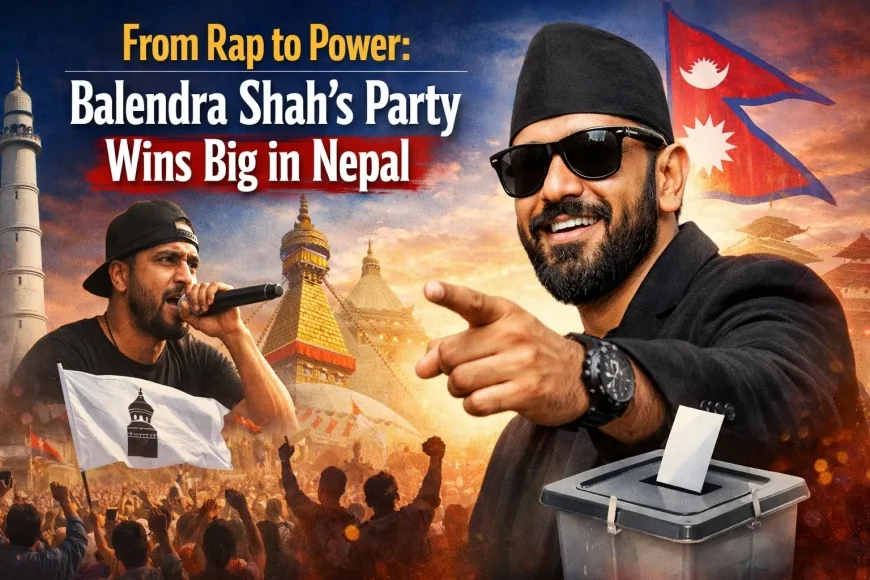
From Rap to Power: Balendra Shah’s Party Wins Big in Nepal
Balendra Shah leads a historic win as Rastriya Swatantra Party secures 182 seats in Nepal elections, signaling a powerful youth-driven political change.

The Rashtriya Swatantra Party (RSP) has won a landslide victory in Nepal's elections—the first since youth protests last year toppled the incumbent government.
The RSP received 182 votes in the final count—two seats short of a two-thirds majority in the lower house of parliament. Nevertheless, this is the largest victory for a single party in Nepal in decades.
The Nepali Congress came in second with 38 seats, while the Communist Party of Nepal UML (CPN-UML) came in third with 25 seats. Nearly 60% of the approximately 19 million eligible voters cast their ballots.
This result puts RSP's Balendra Shah—a rapper-turned-politician—on track to become the country's next leader.
The formation of a new government is expected to take at least a week.
Read Also

This result marks a remarkable turnaround in fortunes for the RSP, which only launched in 2022 and finished fourth in the same year's elections. Shah, like the party he recently joined, is still largely new to political experience—his only political experience to date has been as mayor of the capital, Kathmandu.
This landslide victory is all the more significant because the country's mixed political system—which uses a combination of first-past-the-post and proportional representation—is mathematically designed to prevent any single party from gaining such dominance.
The election result reflects the desire for change that was evident during the election campaign, in which parties wooed Nepal's distinct youth group with promises to address issues such as unemployment, economic stagnation, and inequality.
These were the same issues that fueled last year's youth-led protests, initially against a social media ban. Protesters criticized Nepal's political system and the "Nepo Babies"—children of the country's leaders, who symbolize class inequality.
Software Services

A total of 77 people were killed during the protests, and a investigation revealed that the country's police chief had issued orders authorizing the use of lethal force against thousands of unarmed protesters.
The protests ultimately led to the ouster of then-leader KP Sharma Oli – but he re-ran as a candidate for prime minister, expressing confidence that he would be re-elected.
Not only did his party, the CPN-UML, come in third in the election, but Oli was also soundly defeated by Shah in the Jhapa 5 constituency – a former stronghold of the 74-year-old Oli.
Gagan Thapa, the new leader of the country's oldest democratic party, the Nepali Congress, also lost his seat to the RSP candidate.
Thank you for reading this content.
Thank you for reading this content.
What's Your Reaction?
 Like
0
Like
0
 Dislike
0
Dislike
0
 Love
0
Love
0
 Funny
0
Funny
0
 Angry
0
Angry
0
 Sad
0
Sad
0
 Wow
0
Wow
0