





























Shock Confession: I Beat HIA in 2017 Lions Test
Mark Carney visits Australia to boost trade, defence and Indo-Pacific ties, urging middle powers to unite amid global tensions and trade uncertainty.

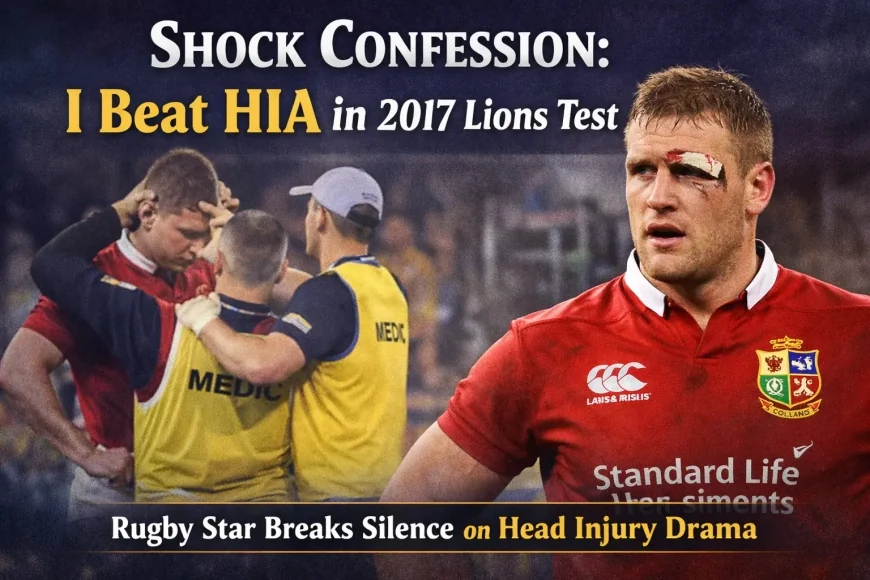
Former British and Irish Lions winger Anthony Watson says he cheated on his head-injury assessment to get back on the pitch after his infamous high tackle on Sonny Bill Williams in the second Test of the 2017 series in New Zealand.
Williams was shown a red card in the 25th minute when, as the winger tried to grab a loose ball and run upfield, he shouldered Watson directly in the head.
Watson says he had memorized a series of five words beforehand to help him pass a portion of the head-injury assessment, which tests players' memory.
Ben Youngs Investigates: How Safe Is Rugby? "I knew the impact was huge, and as I went into the protocol, I started to feel a bit foggy." "I just want to say that I love the Lions' medical staff and they had no idea I was doing this.
"At that point, I knew the protocols—they give you five words to remember, so it's 'elbow-apple-carpet-saddle-bubble.' That's what I had.
Read Also

"I was able to pass the walking test and all that, and then when it came to the words, I had them all memorized, so I knew I was going to walk straight back."
Watson appeared unsteady after the collision, failing his initial attempt to stand up from his knees.
Jack Nowell replaced Watson as he showed concussion symptoms, but six minutes later, Watson ran back onto the pitch and played the rest of the Lions' 24-21 win.
Watson also played 72 minutes in the drawn series decider at Eden Park seven days later.
The recall element of the head injury assessment has since changed.
Instead of asking players to memorize a fixed list of five words, compared to a baseline set at the start of the season with no concussions, a random sequence is drawn from a bank of 20 different words for each assessment.
Players are penalized for incorrect answers, meaning they will fail if they learn and repeat all 20 words.
Software Services

Watson's fellow England winger Jonny May admitted in 2019 that, after suffering a head injury in a game against Wales, he tried to pass the same part of the test by repeating the words but failed.
Players' balance and orientation are also tested, and they must pass all elements of the assessment to play.
Independent doctors also review data from video replays and smart mouthguards to review the collision. In rare cases, if they still have concerns about a player's performance or make a mistake in conducting the assessment, they can change the outcome of the assessment.
Whether the player passes and returns to the field, or fails and leaves the field, they will continue to be assessed in the coming hours and days.
Watson, 32, who retired from rugby in January 2025 after failing to properly heal from a back injury, says he has no regrets about prioritizing that match over his health.
He added, "I was having a mental headache that night."
"But if I could go back then, I wouldn't have done anything differently – it was the second Lions Test. If I reported a concussion there, I could rule myself out for the next week and then wait four years to prevent it from happening again."
Read Also

On the Lions' tour of Australia last summer, Garry Ringrose made a different decision.
The Ireland center was deemed fit to play in the second Test against the Wallabies, but withdrew from the match after experiencing recurrence of concussion symptoms from an incident two weeks earlier.
Regarding Ringrose's decision to withdraw from the field, Watson said, "He's been right." "It's hard to say, 'No, I can't play because I have a concussion,' because no one can see it—it's not visible."
Watson also believes that today's players can't avoid testing like he did.
He added, "It's very difficult to hide it now, and I don't think it's possible."
"I don't think there's a problem [with player safety in rugby].
"As a professional, you accept there are risks in playing the game, but the technology and protocols mean players are safer than ever, and it will only get better."
Thank you for reading this content.
Thank you for reading this content.
What's Your Reaction?
 Like
0
Like
0
 Dislike
0
Dislike
0
 Love
0
Love
0
 Funny
0
Funny
0
 Angry
0
Angry
0
 Sad
0
Sad
0
 Wow
0
Wow
0