











Trump: US to Take Over Venezuela, Rebuild Oil Infrastructure
Trump says the US will run Venezuela after Maduro’s capture, aiming to fix oil infrastructure and drive profits amid global outrage and rising tensions.

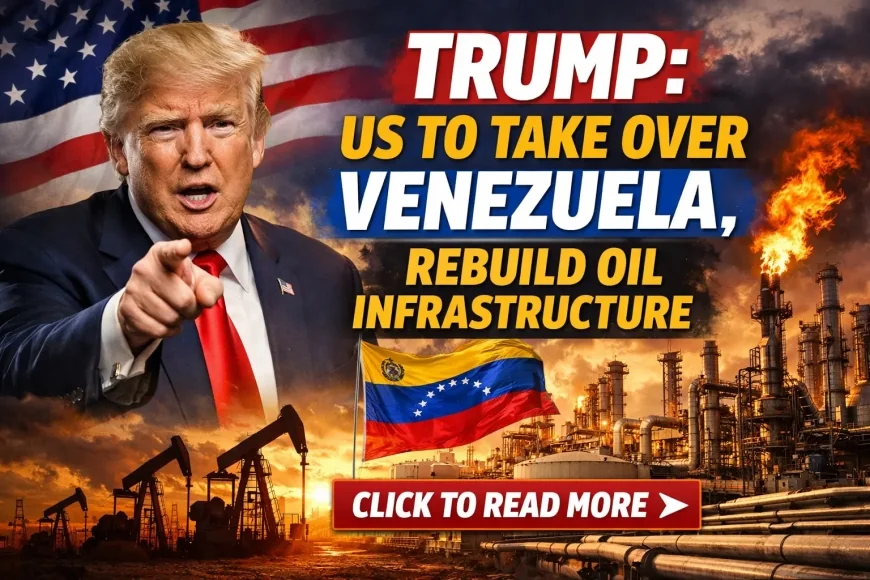
US President Donald Trump has said the United States will "run" Venezuela until a "safe, proper, and sensible transition" is ensured, following US attacks that led to the capture of the country's president, Nicolás Maduro.
Trump added that US oil companies would also fix Venezuela's "broken infrastructure" and "start making money for the country."
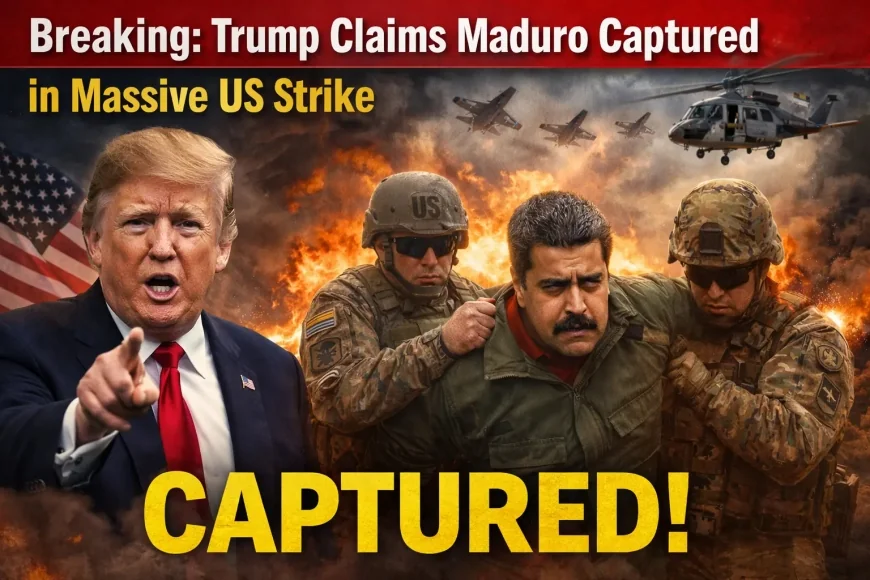
The US launched attacks on Venezuela on Saturday, during which Maduro and his wife, First Lady Cilia Flores, were apprehended by US forces and removed from the country.
Venezuela declared a national emergency and condemned the "military aggression," with the country's vice president stating that Maduro remains their only leader.
Maduro and Flores were taken from the capital Caracas in a US helicopter early Saturday morning and transported to the USS Iwo Jima at an undisclosed location in the Caribbean Sea.
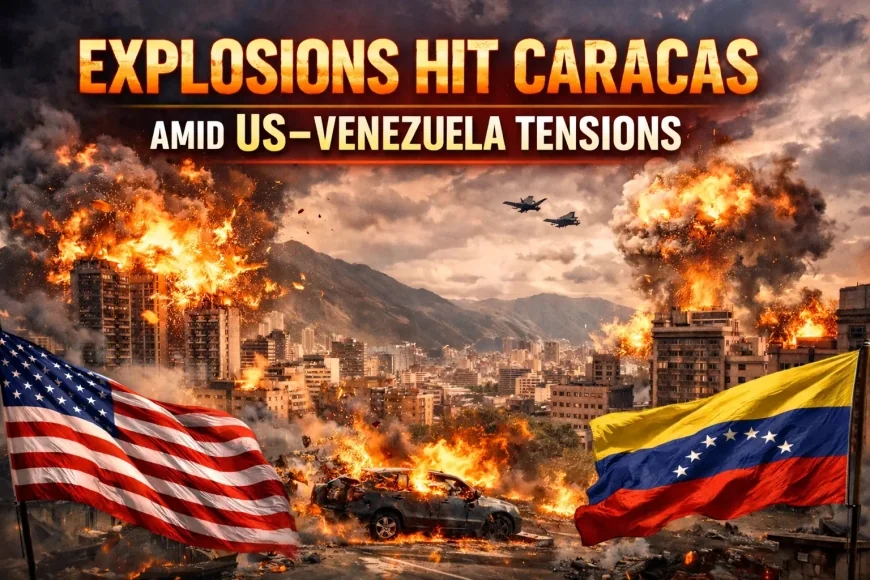
They were later taken to the US naval base at Guantanamo Bay in Cuba, then flown on another aircraft to New York State, and finally transported by helicopter to the Metropolitan Detention Center in Brooklyn, New York City.
US Attorney General Pam Bondi said Maduro and Flores have been indicted in the Southern District of New York.
Both are charged with drug trafficking and conspiracy to import cocaine, possession of machine guns and destructive devices, and conspiracy to possess machine guns and destructive devices against the United States.
"They will soon face the full wrath of American justice in American courts on American soil," Bondi wrote on X (formerly Twitter).
Earlier, Maduro had vehemently denied being a cartel leader and accused the US of using its "war on drugs" as a pretext to remove him from power and seize Venezuela's vast oil reserves. Speaking at a press conference in New York before Maduro's arrival, Trump said: "The oil business in Venezuela has been completely shut down for a long time."
Software Services
 |
All-in-one casino solution ready to launch — talk to our experts now |
"Our great United States oil companies, which are the biggest anywhere in the world, will go in there, spend billions of dollars, fix the badly broken infrastructure, the oil infrastructure, and start making money for the country."
According to the U.S. Energy Information Administration, the South American country has approximately 303 billion barrels of crude oil, representing about 20% of the world's oil resources. It's unclear how the U.S. would "run" Venezuela, but the president said a "group" of people would take charge.
"We'll run it with a group, and we'll make sure it's run properly," Trump said.
When reporters asked who in Venezuela would be part of that group, Trump said Secretary of State Mike Pompeo was speaking with the country's Vice President Delcy Rodríguez.
Trump said Rodríguez had expressed a willingness to do "whatever the United States wants."
However, speaking on state television after Trump's remarks, Rodríguez referred to Maduro as "the only president of Venezuela" and said the government was prepared to defend itself.
Earlier, Rodríguez was the first Venezuelan official to speak publicly after the U.S. attacks, urging the U.S. to provide proof that Maduro and his wife were alive.
Early Saturday morning, the U.S. launched a "massive attack" on Venezuela in which Maduro and his wife were captured by U.S. forces and taken out of the country, subsequently being transported to the USS Iwo Jima.
Venezuela's long-time allies strongly condemned the U.S. action. Russia accused the United States of committing an "act of armed aggression" that was "extremely alarming and reprehensible." China's Foreign Ministry said in a statement that it was "deeply shocked and strongly condemned" the use of force against a sovereign country and its president.
Several Latin American countries, including Venezuela's neighbors Colombia and Brazil, also condemned the action. Cuban President Miguel Díaz-Canel called it a "criminal attack," while in Argentina, Trump ally Javier Milei wrote on social media that "freedom is advancing."
US allies were more restrained in their reactions, urging a peaceful transfer of power. British Prime Minister Sir Keir Starmer said that Britain "considers Maduro an illegitimate president and we have no regrets about the end of his regime."
He added, "The British government will be discussing the evolving situation with our American counterparts in the coming days as we seek a safe and peaceful transition to a legitimate government that reflects the will of the Venezuelan people."
The European Union's top diplomat, Kaja Kallas, and French President Emmanuel Macron also expressed similar sentiments for peace. Macron wrote in a post on X that the new government "must respect the will of the Venezuelan people."
German Chancellor Friedrich Merz said the legality of the US operation was "complex" and that international law should generally apply.
He warned that "political instability must not be allowed to develop in Venezuela."
Since September, the U.S. has launched more than 30 attacks on vessels suspected of drug trafficking in the Pacific and Caribbean, killing more than 100 people.
Software Services
|
Turn your casino idea into a live platform — start your journey today |
The Trump administration has described the attacks on the vessels in the Caribbean and Eastern Pacific as strikes against terrorists attempting to bring fentanyl and cocaine into the United States, although officials have not provided any evidence to support their claims.
With the exception of two survivors—a Colombian and an Ecuadorian national—the identities of those on board the vessels have not been publicly released.
Earlier this week, the conflict escalated further when the U.S. attacked a "dock area" allegedly linked to Venezuelan drug boats.
Fentanyl is primarily manufactured in Mexico and reaches the U.S. almost entirely by land across its southern border.
Drug enforcement experts have also stated that Venezuela is a relatively minor player in global drug trafficking.
It primarily serves as a transit country through which drugs produced elsewhere are smuggled.
Thank you for reading this content.
Thank you for reading this content.
What's Your Reaction?
 Like
0
Like
0
 Dislike
0
Dislike
0
 Love
0
Love
0
 Funny
0
Funny
0
 Angry
0
Angry
0
 Sad
0
Sad
0
 Wow
0
Wow
0