

























UK Government Scraps Mandatory Digital ID for Workers
The UK government scraps mandatory digital ID for workers, shifting focus to public service access while addressing privacy, security, and fraud concerns.

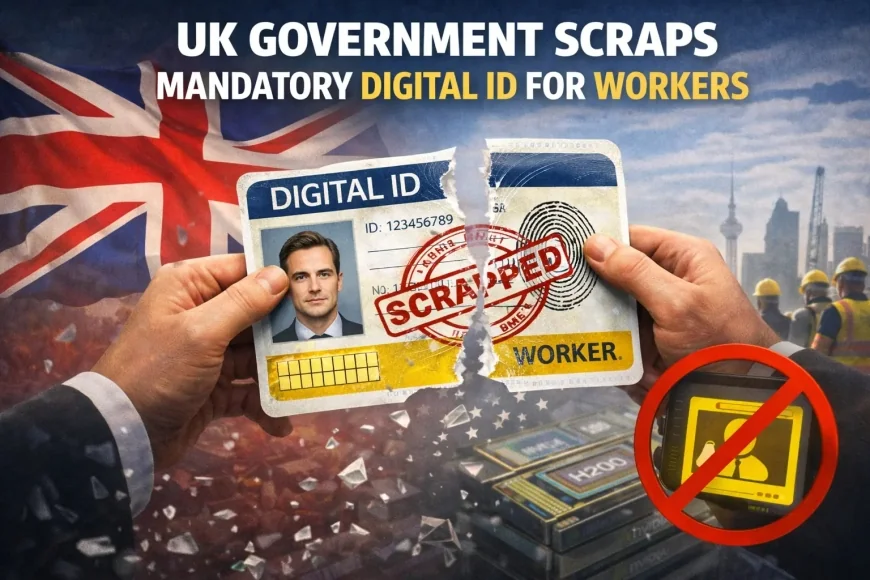
The government has scrapped plans to require workers to sign up to its digital ID scheme to prove their right to work in the UK.
By 2029, right-to-work checks will be conducted digitally – for example, using biometric passports – but registering with the new digital ID program will be optional.
This is a change from last year when the government first announced the policy and Prime Minister Sir Keir Starmer told an audience: "If you don't have a digital ID, you won't be able to work in the United Kingdom. It's as simple as that."
Conservative leader Kemi Badenoch said: "Good. It was a terrible policy anyway."
She said the Labour Party's move showed "another U-turn".
The policy change is the latest in a series of U-turns the government has made since coming to power – including on welfare reforms, cuts to winter fuel payments, and inheritance tax exemptions for farmers.
Read Also

When the government first announced the policy plan, it argued that mandatory digital IDs for workers would make it easier to crack down on undocumented immigrants working illegally.
It is understood that the scheme will now be less focused on immigration enforcement, and the government will instead emphasize the argument that digital IDs can be a useful tool for the public when accessing public services.
Asked about the issue at an Institute for Government conference on Tuesday, Darren Jones, the minister responsible for implementing the policy, said it would be "a pathway to the digital transformation of customer-facing public services".
He said a consultation would be launched "very soon," adding: "I'm confident that this time next year, polling on digital ID will be in a much better place than it is today."
The policy had faced criticism since its announcement last September, with almost three million people signing a parliamentary petition opposing the introduction of digital IDs. There was also unease among some Labour MPs about the mandatory aspect of the original proposal.
The Liberal Democrats said the policy was "doomed to fail" from the start and demanded that the "billions of pounds earmarked for their mandatory digital ID scheme" be spent "instead on the NHS and frontline policing".
Software Services

The party's Cabinet Office spokesperson, Lisa Smart, said: "Number 10 must be having to order motion sickness tablets in bulk at this rate to cope with so many U-turns." Reform UK leader Nigel Farage said in a post on X: "This is a victory for individual liberty against a terrible, authoritarian government. Reform UK will scrap it completely."
Green Party leader Zack Polanski welcomed the news on X, saying: "The government has U-turned on ID cards."
A government spokesperson said: "We remain committed to mandatory digital right-to-work checks.
"Currently, right-to-work checks are a patchwork of paper-based systems, with no record of checks ever being carried out. This leaves scope for fraud and abuse.
"Digital ID will make everyday life easier for people, ensuring public services are more personalised, connected and efficient, while remaining inclusive."
Employers are already required to check that anyone they wish to employ has the right to work in the UK.
Read Also

Since 2022, employers have been able to check British and Irish citizens who hold passports using government-certified digital verification services.
There is also a Home Office online scheme that verifies the status of some non-British or Irish citizens whose immigration status is held electronically.
Details of how the digital ID will work have not yet been finalised, but it is expected to be based on two systems developed by the government: Gov.uk One Login and Gov.uk Wallet. Currently, more than 12 million people have signed up for One Login, which can be used for services such as applying for a veteran's card, canceling a lost passport, or managing a lasting power of attorney.
The Gov.uk wallet has not yet launched, but it will allow people to store their digital ID on their smartphone.
The digital ID will include name, date of birth, nationality and residency status, and a photograph.
Thank you for reading this content.
Thank you for reading this content.
What's Your Reaction?
 Like
0
Like
0
 Dislike
0
Dislike
0
 Love
0
Love
0
 Funny
0
Funny
0
 Angry
0
Angry
0
 Sad
0
Sad
0
 Wow
0
Wow
0