






























7 Iranian Footballers Granted Asylum in Australia
Australia grants protection to Iranian footballers asylum seekers after anthem controversy, with seven team members choosing safety and residency in Australia.

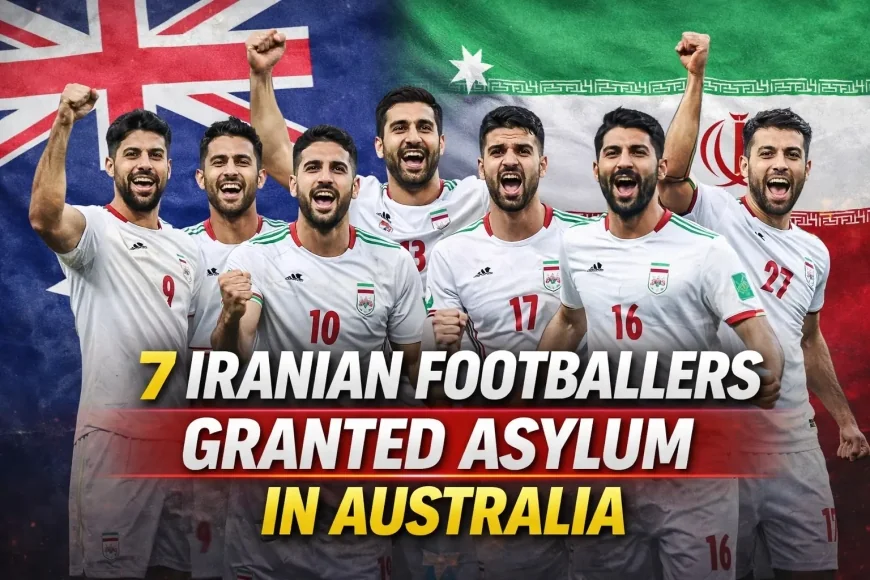
Australia has confirmed that two more members of the Iranian football team have accepted an offer to stay in the country and will be granted humanitarian visas.
The pair – a player and a member of the support staff – have now been reunited with the remaining five players who were granted visas to stay on Tuesday.
They were granted asylum after concerns were raised about the team's safety when they did not sing the national anthem before last week's match against South Korea.
The remaining Iranian players are understood to have left Australia on Tuesday night local time – two days after their Asian Cup exit.
The remaining pair were separated from the rest of the squad at their hotel on the Gold Coast – after stating their wish to remain – and taken to a police facility in Brisbane, Immigration Minister Tony Burke said.
Burke said all seven will be fast-tracked for permanent residency.

He further stated that the offer to stay was reiterated to "most" of the remaining delegation at Sydney Airport before leaving the country on Tuesday night.
Burke said that a "heavy" police presence at Sydney Airport ensured that players remained separated from their teammates while speaking face-to-face with officers through translators, and were given the opportunity to call their families.
Burke said that none of them accepted the offer to stay, but he also said that one person boarded the plane "significantly late" after speaking with his family.
Burke said, "That person made their own decision" – noting that they were under no pressure to take the flight.
He also said that some members of the traveling group were not invited to stay – believed to be referring to associates of the Iranian government.
He said, "Some people are leaving Australia and I'm glad they're not in Australia."
The team arrived at Sydney Airport on Tuesday evening from the Gold Coast, where the Asian Cup is being held. Members of the Australian-Iranian community gathered there to support them and protest their return to Iran.
Software Services
 |
Build a profitable gaming business with 500+ games — book a demo |
He said some members of the team had gestured for help. Burke, quoted by the ABC, said Border Force officials had spoken to the team "several times" before leaving Sydney, including "private meetings."
Local media reported that at least one player refused to board their subsequent flight to Malaysia while returning to Iran.
But some players—who were accompanied by teammates—reportedly told reporters that they wanted to return to Iran.
Australia's Humanitarian Visa Program provides permanent protection to refugees and people in humanitarian need. Visa holders can live, work, and study in the country.
It is unknown what consequences the team and their families may face in Iran following the players' refusal to sing the national anthem.
A conservative commentator on Iranian state media accused them of being "wartime traitors" and demanded severe punishment.
The team sang the national anthem in their last two games before being eliminated on Sunday, leading critics to believe they were forced to participate by government officials accompanying them as part of the tournament delegation.

Earlier on Tuesday, a bus carrying team members was briefly blocked by activists as it left their hotel on the Gold Coast. Some carried the Lion and Sun flag, the official flag of Iran before the Islamic Revolution.
Meanwhile, those who had received humanitarian visas left the team hotel and were escorted to safety by police.
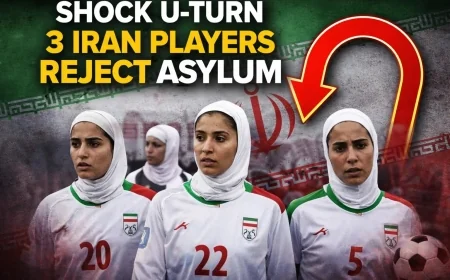
Burke identified them as Fatemeh Pasandideh, Zahra Ghanbari, Zahra Sarbali, Atefeh Ramazanzadeh, and Mona Hamoodi.
Burke said, "They want to make it clear that they are not political activists. They are athletes who want to be safe," and added that discussions had been ongoing for several days.
Speaking to other team members before leaving Australia, he said: "This is the opportunity. Australia has embraced the Iranian women's soccer team. These women are very popular in Australia."
Australian Prime Minister Anthony Albanese said at a press conference on Tuesday, "The people of Australia are emotional seeing the plight of these brave women." "They are safe here, and they should feel at home here."

The plight of the Iranian players has also come to the attention of US President Donald Trump, who demanded action on his Truthout social platform.
He said Australia should provide "asylum" to the women or "if you don't, the US will take them."
About an hour later, Trump posted again to say he had spoken to Australian Prime Minister Anthony Albanese, writing: "Five have already been taken care of, and the rest are on the way".
The Trump administration late last year suspended all asylum decisions and stopped granting immigrant visas to citizens of dozens of countries, including Iran. The administration stated that it wanted to "end the abuse" of the system.
Last year, two groups of Iranians—including those whose asylum applications had failed—were deported from the US back to Iran. These groups reportedly included members of the LGBT community, who face serious legal and social consequences in Iran.
Thank you for reading this content.
Thank you for reading this content.
What's Your Reaction?
 Like
0
Like
0
 Dislike
0
Dislike
0
 Love
0
Love
0
 Funny
0
Funny
0
 Angry
0
Angry
0
 Sad
0
Sad
0
 Wow
0
Wow
0