


























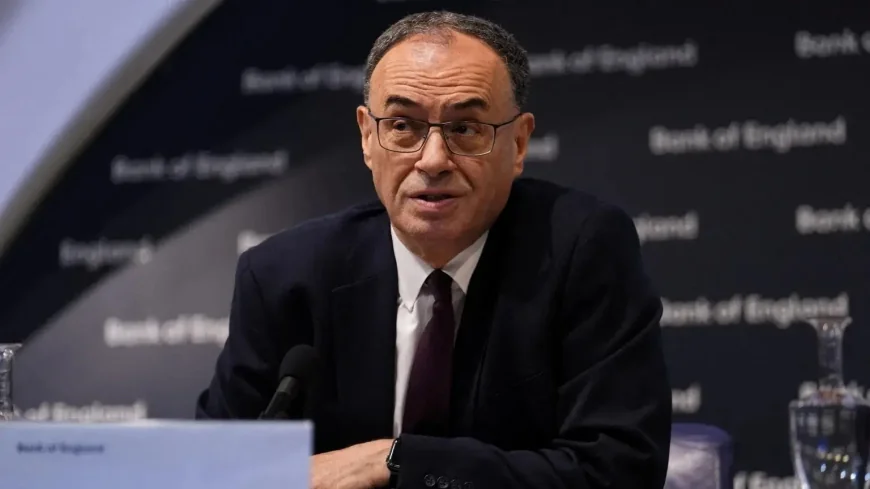
Bank of England Governor,Santa or Scrooge on Interest Rates?
Bank of England Governor Andrew Bailey expects inflation to fall to around 3% early next year.

There's a lot of activity outside the Bank of England.
City workers are taking advantage of the unusually pleasant weather to enjoy lunch outside, and the temperature has also shifted inside the Bank.
The decision to keep interest rates at 4% was a very close call, and the interest rate panel believes that inflation has peaked.
Governor Andrew Bailey said he wanted to see whether upcoming developments confirm this view before considering cutting rates; weakness in the labour market could also play a role.
The Bank also noted that last year's budget measures – such as increases in employer National Insurance contributions and the minimum wage – put upward pressure on prices last year.
A key factor in future decisions will be the upcoming budget, which could ease price pressures through direct measures on bills, but tax increases could also take money out of people's pockets.
The Chancellor has been keen to take credit for creating the right environment for a rate cut. But the Bank's report makes it clear that last year's budget measures put upward pressure on prices, and increased employer costs have led to reluctance to hire.
Ironically, it is perhaps the impact on the labour market that has contributed to the thinking of rate-setters who are already considering lowering borrowing costs.
While the Bank itself declined to speculate on the budget measures, it indicated that concerns elsewhere among consumers and businesses could hold back the economy.
With consumer spending remaining cautious, it expects the economy to grow by 1.2% in 2026, down from this year's forecast of 1.5% – which will not be welcome news at the Treasury. The interest rate panel will have a lot to weigh up in the budget – the scale and nature of tax rises, help with energy bills and potentially other cost of living challenges, and the increase in the National Living Wage.
According to the Bank's research, labour costs remain a key uncertainty for both employers and consumer prices.
Rate-setters will have to assess the impact of these policies – and the usual monthly evidence on inflation, jobs and so on – by their next meeting in mid-December. In effect, by casting their vote, the Governor and his colleagues will decide whether to be Santa or Scrooge.
If not then, economists believe a cut will come in February.
And how many more after that?
The Bank says it expects to see rates "gradually falling". Some members are still concerned about persistent inflationary pressures.
For example, its research suggests that our expectations about inflation are shaped by recent experience, and particularly by fluctuations in food prices.
We are still reeling from the massive price increases of the last few years, and this can lead people and businesses to behave as if inflation is higher than it actually is – by demanding higher wages or raising prices.
Meanwhile, millions of homeowners will face rising costs when they renew their mortgages because rates are still higher than they were a few years ago: they haven't come down as quickly as they went up.
Borrowers can expect more gifts in 2026, but they will come slowly.
What's Your Reaction?
 Like
0
Like
0
 Dislike
0
Dislike
0
 Love
0
Love
0
 Funny
0
Funny
0
 Angry
0
Angry
0
 Sad
0
Sad
0
 Wow
0
Wow
0