

























Breonna Taylor Case: Judge Blocks Louisville Police Reform Deal
A federal judge dismissed Louisville’s police reform deal tied to the Breonna Taylor case, reigniting debate over police accountability and justice reform.

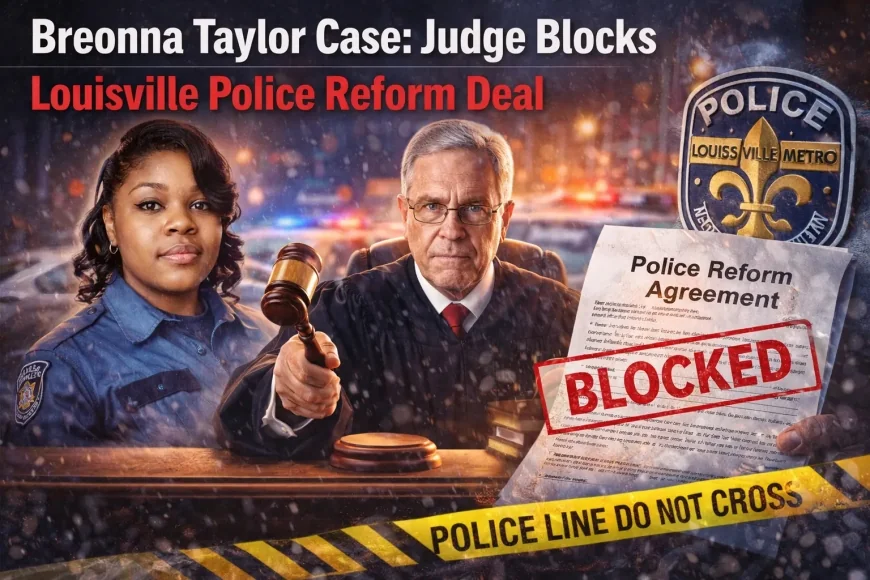
A federal judge in Kentucky has rejected a proposed agreement between Louisville and the U.S. Justice Department regarding police reforms, after the department withdrew its support for the plan earlier this year.
The Justice Department announced in May that it was rescinding proposed consent decrees with Louisville and Minneapolis, which were intended to address police racial bias and misconduct following the killings of George Floyd and Breonna Taylor, which sparked nationwide protests in the summer of 2020.
U.S. District Judge Benjamin Beaton wrote in a December 31 ruling that “the responsibility for ensuring that the Louisville Metro Police Department operates in accordance with federal law should remain with the city’s elected representatives and the people they serve.”
A judge in May rejected the proposed consent decree for Minneapolis, which would have placed a federal monitor in charge of overseeing progress on the reforms outlined in the agreement.

Justice Department officials under President Joe Biden’s administration conducted a multi-year investigation into Louisville following Taylor’s fatal shooting and the police response to public protests in 2020. A draft of the investigation was released in early 2023, alleging that the Louisville Police Department “discriminates against Black people in its enforcement activities,” uses excessive force, and conducts searches based on invalid warrants.
The Justice Department’s new leadership has accused the Biden Justice Department of using flawed legal theories to evaluate police departments and pursuing costly and burdensome consent decrees.
The consent decrees with Louisville and Minneapolis were approved by the Justice Department in the final weeks of the Biden administration, but the agreements still needed to be approved by a judge.
Software Services
 |
Turn your casino idea into a live platform — start your journey today |
Beaton wrote that his ruling “does not prevent the parties from undertaking the difficult work of reform themselves.”
Louisville Mayor Craig Greenberg pledged to continue with reforms after the Justice Department withdrew its support in May. The city developed a local police reform plan and appointed an independent law enforcement consulting group as a monitor. Greenberg said that some of the progress expected in 2025 includes addressing the backlog of open records requests and making police shooting body camera video public within 10 business days.
In a statement Friday, the mayor's spokesperson said Greenberg is "committed to ongoing reforms" and "has done something no other mayor in the country has done — he voluntarily created and implemented Louisville's own reform plan."

The city implemented some reforms after Taylor's death in March 2020, including a city ordinance banning the use of "no-knock" warrants. These warrants were commonly used in surprise drug raids. The city has also launched a pilot program that dispatches behavioral health professionals to some 911 calls.
Last year, former Louisville police detective Brett Hankison became the first officer involved in the Taylor raid to be sentenced to prison. A judge sentenced Hankison to nearly three years in prison, despite the Justice Department's attempt to reduce his sentence to just one day.
Taylor's boyfriend fired at police from inside her apartment, after which Hankison fired 10 rounds. Hankison fired indiscriminately into Taylor's windows, but no one inside or in neighboring apartments was struck.
Thank you for reading this content.
Thank you for reading this content.
What's Your Reaction?
 Like
0
Like
0
 Dislike
0
Dislike
0
 Love
0
Love
0
 Funny
0
Funny
0
 Angry
0
Angry
0
 Sad
0
Sad
0
 Wow
0
Wow
0