






























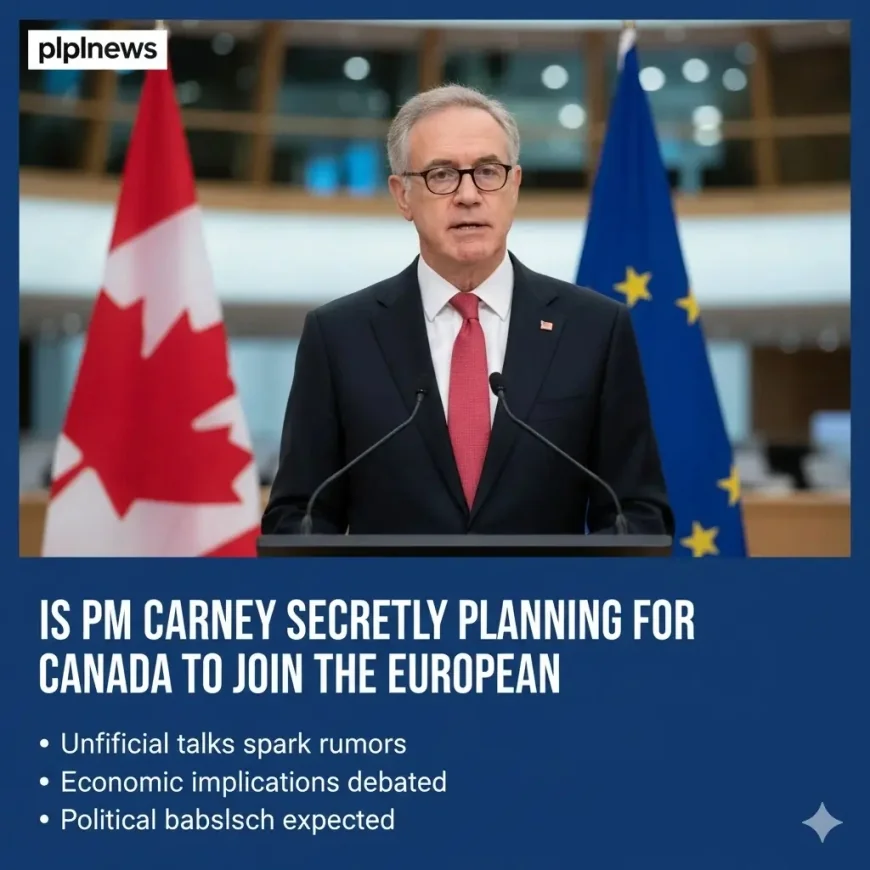
Is PM Carney Secretly Planning for Canada to Join the European
As Trump revives trade pressure, Canada faces an uneven fight. Experts reveal how Ottawa can win the U.S. trade war using USMCA leverage and strategy.

On Wednesday, the U.S Court of International Trade struck down President Donald Trump’s most sweeping tariffs. But the decision, while favourable to Canada, has already been stayed pending an appeal, and it does not cover all such duties. And even if Mr. Trump ultimately loses in the courts, he can simply find other ways to impose tariffs.
Canada continues to stare down the barrel of the American trade war. The United States-Mexico-Canada Agreement faces its first big review in 2026. This country remains in a uniquely high-stakes moment.
 |
Turn your casino idea into a live platform — start your journey today. |
Prime Minister Mark Carney came to power on a promise to rewrite the playbook and a declaration that the old, cozy Canada-U.S. relations are “over.” Tuesday’s Throne Speech, delivered by King Charles III, outlined an economic strategy focused on fostering domestic innovation, enhancing productivity and reducing reliance on U.S. trade.
But make no mistake: This will, and will always be, an uneven fight. Canada is 40 million people and only the world’s ninth largest economy. A middle power is going up against the world’s richest and most powerful country, on whose dynamism it is unusually dependent. How exactly is it even possible for Canada to win in this asymmetric trade war?
Crucially, this conflict isn’t just about steel, soybeans or softwood lumber – it’s about narrative and power. This time, a tariff isn’t just a tax; it’s a message. U.S. President Donald Trump frames trade deficits as proof that the United States is “losing” – a zero-sum narrative in which he casts himself as the country’s saviour. What was once a rules-bound negotiation now feels more like a bizarre reality show starring the global economy.
For Canada, winning will require strategic creativity and a dash of against-the-grain thinking. The Globe and Mail asked experts on how, in a conflict fought as much on stage as in the marketplace, Canada can craft a savvy new script.
Paradoxically, Canada’s path to winning the next trade war lies in giving the U.S. administration what it wants – publicly. But only when the substance still works in our favour.
The 2026 USMCA review will not be a legal negotiation; it will be a political performance. The Trump administration will seek loud, symbolic victories. Canada must prepare now to offer performative wins that cost little – or even buy us leverage in return.
We‘ve seen this strategy succeed. In 2018, when Mr. Trump threatened auto tariffs on Europe, the European Union defused the crisis with performative concessions, agreeing to buy more American soybeans and liquefied natural gas, both of which it was already importing. Mr. Trump got a press-conference win. Europe kept its industrial base untouched. In automotive, we can accept a modest increase in U.S. content thresholds, but only if tied to a binding trilateral electric vehicle and critical parts supply chain agreement that includes Mexico. This would lock in U.S. reliance on Canadian battery minerals and processing, a real strategic gain wrapped in a symbolic concession.
Border security? Codify existing controls in a bilateral framework. It lets Mr. Trump claim he “hardened the border,” even if Canada is already acting. Appearances win the press conference; substance shapes the future.
But in one domain, the concession is real and should be used as leverage: defence. Canada will increase procurement in coming years regardless, to meet NATO and NORAD commitments. By announcing strategic defence buys from U.S. firms early, we give Mr. Trump a concrete “Made in America” win – and gain negotiating space elsewhere. This is where optics align with long-term need.
The point is not to win louder. It’s to win smarter. Performative concessions – if scripted early and sequenced well – can neutralize trade aggression while embedding Canadian advantage across sectors. The art is to give headlines in exchange for leverage. And in trade wars, that’s the only kind of winning that lasts.
Canada must now apply the same choreography – but do it better. Start with dairy. Rather than stonewall, Canada should offer a reasonable quota expansion for U.S. milk protein concentrate – surplus supply with limited market threat. It feeds the U.S. narrative of “cracking supply management,” while the system itself remains intact.
Canada must now apply the same choreography – but do it better. Start with dairy. Rather than stonewall, Canada should offer a reasonable quota expansion for U.S. milk protein concentrate – surplus supply with limited market threat. It feeds the U.S. narrative of “cracking supply management,” while the system itself remains intact.
Thank you for reading this content.
If you find it helpful, then checkout : https://plplnews.com/snl-roasts-trump-epstein-kennedy-center
Also check out the latest Mercedes : https://plplnews.com/gorden-wagener-mercedes-iconic-designs

What's Your Reaction?
 Like
0
Like
0
 Dislike
0
Dislike
0
 Love
0
Love
0
 Funny
0
Funny
0
 Angry
0
Angry
0
 Sad
0
Sad
0
 Wow
0
Wow
0