


























Minnesota’s Historic Strike Shuts Down Economy to Protest ICE
Hundreds of Minnesota businesses closed as protesters launched an economic strike against ICE, citing immigration enforcement fears and economic harm.

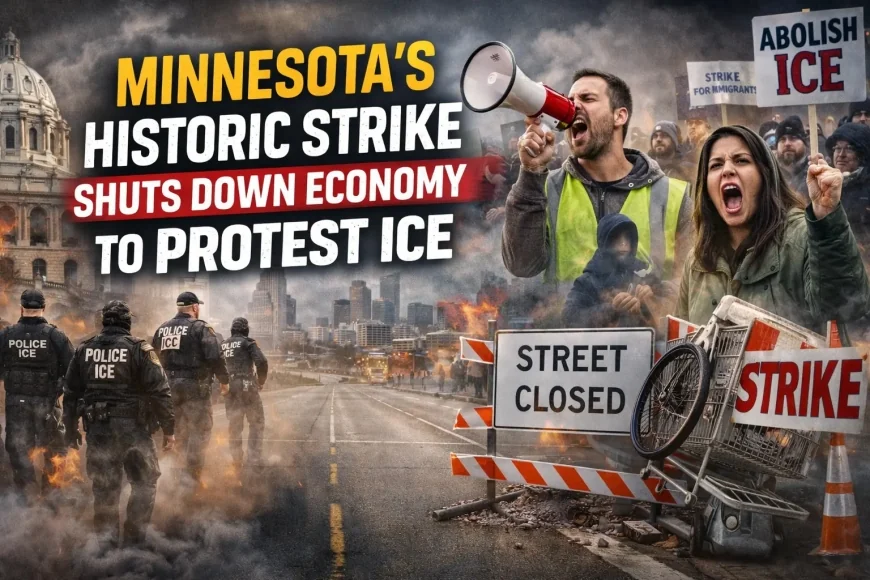
Hundreds of businesses in Minnesota closed on Friday as part of an economic protest against the strict enforcement of immigration laws in the state.
Organizers urged people to stay home from work or school and refrain from shopping to show their opposition to U.S. Immigration and Customs Enforcement (ICE).
They also planned rallies in St. Paul and Minneapolis, two cities that have seen a significant increase in immigration enforcement activity.
The Trump administration describes immigration enforcement as a public safety operation aimed at removing alleged criminals who are in the country illegally. Critics say that immigrants without criminal records and even U.S. citizens are being detained.
Thousands of federal officers have been deployed to Minnesota under "Operation Metro Surge." On Wednesday, Department of Homeland Security spokeswoman Tricia McLaughlin said in a statement that since President Donald Trump took office a year ago, the government has arrested "10,000 criminal illegal aliens in Minnesota."
But the killing of 37-year-old Minneapolis resident Renee Good earlier this month has sparked widespread protests and condemnation from local officials across the state.
While many protests have been peaceful, some have escalated into violent clashes between protesters and federal officers.
"We want ICE out of Minnesota, and we want ICE out of every state, with their overreach," said Bishop Dwayne Royster. His organization, Faith in Action, is supporting local partners in Minneapolis during the strike. "We want Congress to step up and provide oversight of ICE."
On Friday morning, Minneapolis resident Cory Lamb closed his business, Harriet Grove Botanicals, and went to join the protest. He objected to the presence of ICE agents in his city, and was deeply angered by the death of Good in early January.
He also viewed the immigration raids as an economic threat to his business and to others in his community.
“We have a lot of friends that we rely on, we have a lot of businesses that we rely on to keep our businesses going,” he said. “When those people are struggling because they’re afraid of being detained or disappearing, it’s having an impact not only morally but economically here and throughout the Midwest.”
Software Services
 |
Start your own gaming platform for just $3,000 |
Mr. Lamb’s business, along with hundreds of others, is expected to be closed, including restaurants and businesses ranging from tattoo parlors to toy stores. Kim Bartmann owns six restaurants in Minneapolis, four of which are typically open during the winter, but she closed all of them on Friday. While she supports the cause, she said the decision to participate was difficult given the expenses.
“Everyone is united, but everyone still has to buy groceries and pay rent,” she said, explaining that the staff at one of her restaurants initially decided to stay open but later determined that the risk of not participating was too great.
“Economically, it’s a huge blow to my business,” she said.
She said her restaurants, which include Barbette and Gigi’s Cafe, have already seen a more than 30% drop in sales over the past three weeks due to ICE operations, forcing her to reduce hours because customers and staff are staying home.
“We have a lot of employees who are U.S. citizens or have papers to work in the U.S., but they’re still afraid to leave their homes,” she said.

Many Minnesota residents are angered by the ICE presence and have protested against their operations and other federal officers working in the city. This week, school officials in the suburb of Columbia Heights announced that four of their students, ranging in age from five to 17, had been taken into custody by ICE.
In a speech on Thursday, Vice President J.D. Vance called on local law enforcement in Minnesota to coordinate with federal authorities to enforce immigration laws.
Minnesota, and some of its cities, have so-called "sanctuary" policies that limit the ways in which local government and law enforcement cooperate with ICE. The Trump administration has criticized these policies as a threat to public safety.
"We can all do a much better job of de-escalating the situation," Vance said. "But the most important thing I learned today is that the best way to properly enforce the law and reduce chaos in Minneapolis is for state and local officials to cooperate."
Thank you for reading this content.
Thank you for reading this content.
What's Your Reaction?
 Like
0
Like
0
 Dislike
0
Dislike
0
 Love
0
Love
0
 Funny
0
Funny
0
 Angry
1
Angry
1
 Sad
0
Sad
0
 Wow
0
Wow
0