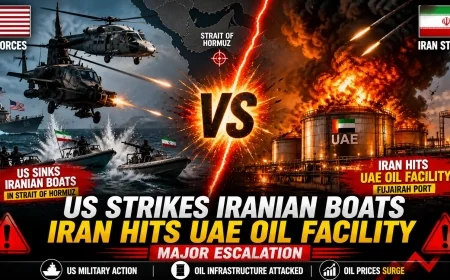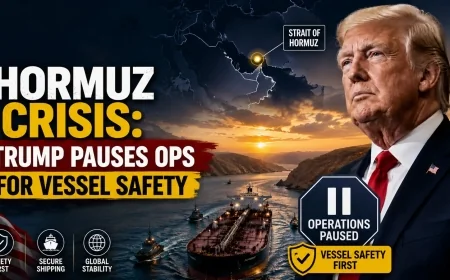
































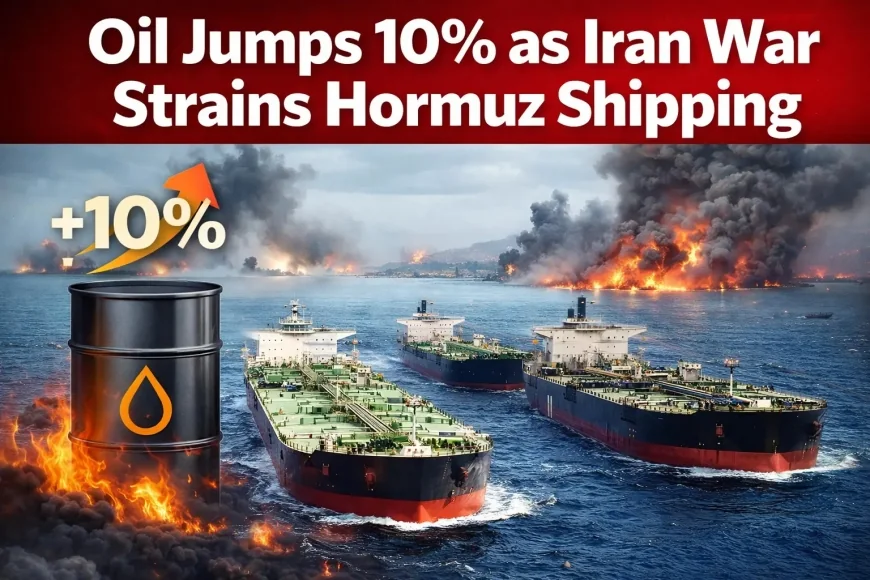
Oil Jumps 10% as Iran War Strains Hormuz Shipping
Brent crude jumps 13% as Iran conflict halts traffic through the Strait of Hormuz, threatening 15M barrels per day and rattling global markets.

Oil prices rose and stock markets came under pressure on Monday after US-Israeli attacks on Iran raised fears of economic turmoil worldwide.
Brent crude jumped 13% in early trading to $82 per barrel, a 14-month high. The closure of the Strait of Hormuz, one of the most vital routes for global trade, raised concerns about oil supplies.
The image shows a map of the Strait of Hormuz, Iran, and a 3D-printed oil pipeline. What is the Strait of Hormuz and why is it important for oil supplies?
Read more
In Tokyo, the Nikkei 225 fell nearly 2.4% as traders in Asia reacted to the weekend's developments. It later recovered and traded 1.5% lower. Pre-market trading also set Wall Street for a lower opening on Monday.
The ASX 200 in Sydney opened sharply lower, then recovered to trade down about 0.4%. The CSI 300 in Shanghai fell 0.6%.
Read Also
Gold, often considered a safe-haven asset by investors during times of crisis, rose 2.8% to $5,397.10 per ounce.
There was no sign of a let-up in US and Israeli military attacks on Iran, with Donald Trump saying the conflict could last four more weeks and vowing to continue until US targets were met.
While oil prices fell slightly from their opening high, Brent was up 4% in early trading.
As prices rose, all eyes were on the Strait of Hormuz – through which about a fifth of oil supplies and seaborne gas tankers pass.
Within hours of Saturday's US-Israeli attacks, Tehran reportedly warned tankers in the Strait that no ships would be allowed to pass.
According to the British maritime security agency, United Kingdom Maritime Trade Operations (UKMTO), two ships have been attacked in the Strait, one near Oman and the other near the UAE.
Although Iran has not yet officially confirmed that the vital waterway has been blocked, marine tracking sites indicate that tankers are gathering on both sides of the Strait, either due to fear of attack or perhaps lack of insurance for the voyage.
Software Services

The International Maritime Organization has urged ships to avoid the Strait of Hormuz. Its Secretary-General, Arsenio Domínguez, expressed deep concern over reports that several sailors were injured in the attacks.
Domínguez said, "I urge all shipping companies to exercise maximum caution." "To the extent possible, ships should avoid transiting the affected area until the situation improves." Shipping multinational Maersk announced on Sunday that it was halting its transit through the Strait of Hormuz and the Suez Canal, another vital part of the world economy, citing "safety" reasons. On Sunday, the Opec+ cartel of producing countries agreed to increase oil production by 206,000 barrels per day for April, but much of that product still needs to be shipped out of the Middle East by tanker.
Iran is one of the cartel's largest producers, pumping 4.5% of global supply, so any disruption to its shipments could have a ripple effect on the broader market.
"The most immediate and concrete development impacting the oil market is the complete halt of traffic through the Strait of Hormuz, preventing 15 million barrels of crude oil from reaching the market each day," said George Lyons, head of geopolitical analysis at Rystad Energy. "Unless signals of de-escalation emerge quickly, we expect oil prices to remain significantly higher."
Thank you for reading this content.
Thank you for reading this content.
What's Your Reaction?
 Like
0
Like
0
 Dislike
0
Dislike
0
 Love
0
Love
0
 Funny
0
Funny
0
 Angry
0
Angry
0
 Sad
0
Sad
0
 Wow
0
Wow
0