
































Shock U-Turn: Iran Football Captain Drops Asylum Bid
Iran women’s football captain and four teammates withdraw their asylum bid in Australia amid pressure claims, leaving only two defectors from the Asian Cup squad.


The captain of Iran's women's football team has withdrawn her application for asylum in Australia. According to Iranian state media, she is the fifth member of the team to do so.
Australian authorities have also confirmed that another member of the team has withdrawn her asylum application, though they have not disclosed that member's identity. This development emerged just one day after officials reported that three other women on the team had also withdrawn their asylum applications.
These female footballers had initially sought asylum out of fear that they could face severe repercussions for remaining silent while the national anthem was played during their opening match of the Asian Cup.
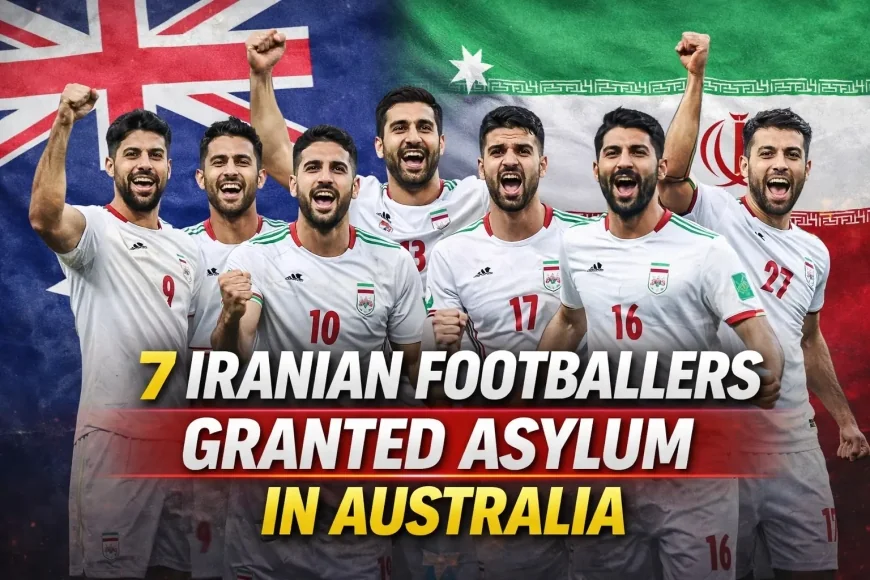
This latest withdrawal means that of the seven members who initially accepted Australia's offer of humanitarian visas, only two now remain in the country as asylum seekers.
Human rights activists suggest that these women may have been pressured—possibly through threats directed at their families—to reverse their decisions.
Shiva Amini, a former Iranian national futsal player currently living in exile, stated that she has received information indicating that the Iranian Football Federation—which operates in conjunction with the Islamic Revolutionary Guard Corps (IRGC)—is "exerting immense and systematic pressure on the families of these players back in Iran."
In a post on X (formerly Twitter) on Sunday, she wrote: "Several players on the team decided to return because the threats being directed at their families had become unbearable, and the campaign of intimidation against them was relentless."
Iranian media has heaped praise on Ghanbari for her decision. Iran's state news agency, IRNA, stated that she is "returning to the bosom of her motherland," while the semi-official news agency, *Mehr*, described it as a "patriotic decision." On Saturday, three other members of the team also withdrew their applications for asylum in Australia. Human rights activists living outside Iran have identified these members as Zahra Soltan Meshkehkar, Mona Hamoudi, and Zahra Sarbali.
Confirming the decision of these members, Australia's Minister for Home Affairs stated that his government had made every possible effort to ensure that these women had the opportunity to build a safe future for themselves in the country.
Software Services

In a statement, Tony Burke said, "Australians should be proud that, right here in our own country, these women encountered a nation that offered them genuine opportunities to make choices of their own free will—a place where officials did their utmost to assist them."
He further added, "While the Australian government can ensure that opportunities are extended to these women—and that they are fully informed about those opportunities—we cannot alter the social and political climate whose pressures are compelling these athletes to make such difficult decisions." In a statement, Iran's Ministry of Sport asserted that "the national spirit and patriotism of the Iranian women's national football team have defeated the enemy's schemes against the squad," adding that the Australian government was "playing on Trump's side."
Tasnim, a news agency affiliated with the IRGC, reported that the trio was traveling to Kuala Lumpur, Malaysia, to rejoin the rest of the team, and that they were "returning to the warm embrace of their families and their motherland."
The agency claimed that, while in Australia, they had steadfastly withstood "psychological warfare, extensive propaganda, and enticing offers."
Australian Minister Kristy McBain dismissed this statement as "propaganda."
"I believe our government has maintained complete transparency with the Australian public regarding the steps we took to ensure that these women from the Iranian football team—along with their support staff—were afforded every possible opportunity to make their own decisions."
Read Also

Last week, one player changed her mind; Subsequently, two other players and a staff member followed suit, and they departed Australia on Saturday.
Concerns surrounding the Iranian team escalated after they refused to sing the national anthem during their opening Asian Cup match against South Korea on March 2—an act that led to them being branded "wartime traitors" back in Iran, sparking calls for severe punishment.
The team did sing the national anthem during their final two matches before being eliminated from the tournament, giving critics grounds to believe that government officials accompanying the squad had instructed them to do so.
The remaining Iranian players departed Australia on March 10—two days after their elimination from the Women's Asian Cup.
This entire football-related saga has unfolded against the backdrop of the ongoing conflict in the Middle East, where Iran has launched retaliatory strikes across the region in response to attacks carried out against it by the United States and Israel.
Thank you for reading this content.
What's Your Reaction?
 Like
0
Like
0
 Dislike
0
Dislike
0
 Love
0
Love
0
 Funny
0
Funny
0
 Angry
0
Angry
0
 Sad
0
Sad
0
 Wow
0
Wow
0