











Venezuelan Nobel Winner Offers Peace Prize Medal to Trump
Venezuelan opposition leader María Corina Machado presents her Nobel Peace Prize medal to Donald Trump, sparking global debate over US–Venezuela diplomacy.

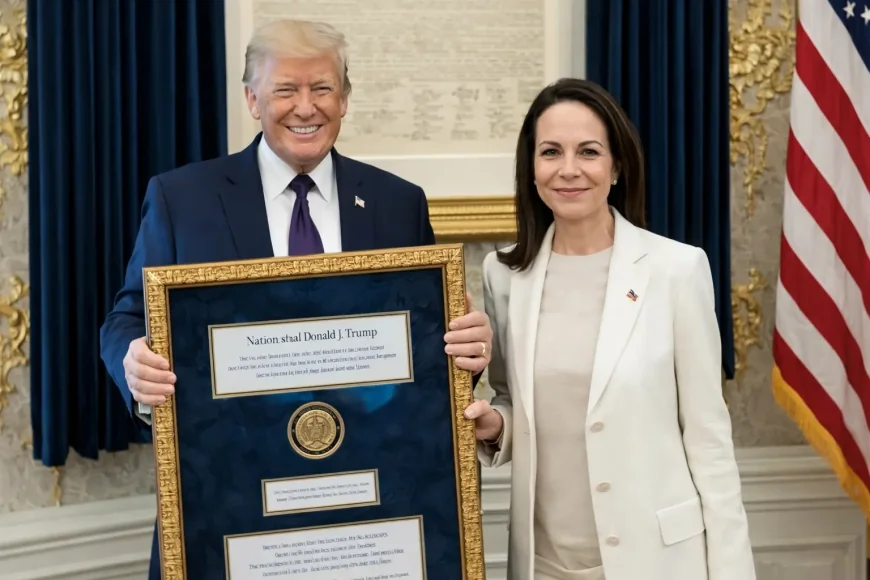
Venezuelan opposition leader María Corina Machado told reporters that she gave President Donald Trump her Nobel Peace Prize medal during a private meeting at the White House on Thursday, but did not say whether he accepted it.
After meeting with Trump, she said, "I think today is a historic day for the people of Venezuela." It was the first time the two had met in person.
Weeks after US forces detained Venezuelan President Nicolás Maduro in Caracas, Trump declined to endorse Machado, whose movement had claimed victory in the widely disputed 2024 elections and declared her their new leader.
Instead, he has been speaking with the country's acting head of state, Delcy Rodríguez, Maduro's former vice president.
After leaving the White House, Machado spoke to supporters gathered outside the gates, telling them in Spanish, according to the Associated Press: "We can count on President Trump."
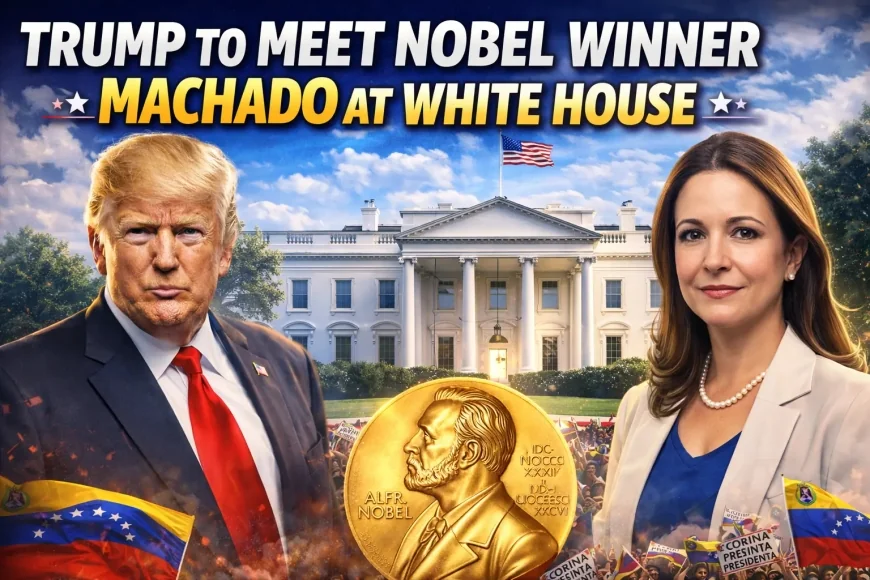
Machado later told reporters in English, "I gave the President of the United States the Nobel Peace Prize medal," calling it "a recognition of his unique commitment to our freedom."
It is unclear whether Trump accepted the award. Trump, who frequently speaks of his desire to win the Nobel Peace Prize, expressed displeasure last year when the award was given to Machado and she decided to accept it.
Machado had said last week that she would share it with Trump, but the Nobel Committee later clarified that it is not transferable.
"Once a Nobel Prize is announced, it cannot be revoked, shared, or transferred to others," the committee said in a statement last week. "The decision is final and valid forever." When asked to comment on Machado's remarks, the committee referred the BBC to its previous statement.
Before Thursday's White House meeting, the Nobel Peace Center posted on X that "a medal can change hands, but the title of Nobel Peace Prize laureate cannot."
In her remarks, Machado recounted how the Marquis de Lafayette, who fought in the American Revolutionary War, had given a medal bearing George Washington's image to Simón Bolívar, one of the founders of modern Venezuela.
Machado said the gift symbolized "the brotherhood between our country and the United States in the fight for freedom against tyranny." She added, "And 200 years later in history, Bolívar's people are giving a medal to Washington's successor—in this case, the Nobel Peace Prize medal—as recognition of his unique commitment to our freedom."
Software Services
 |
Start your own gaming platform for just $3,000 |
Machado also visited Congress during her Washington trip to meet with US senators, where her remarks to reporters were drowned out by supporters chanting "Maria, President" and waving Venezuelan flags.
Machado was expected to use her time with Trump to try to convince him that supporting the interim government of Juan Guaidó was a mistake, and that her opposition coalition should be given the responsibility for the transition.
White House Press Secretary Karoline Leavitt told reporters on Thursday, while the meeting was underway, that Machado "is a remarkable and courageous voice for many Venezuelans" and that Trump "was looking forward to this meeting and to having an open and productive discussion about the current realities of life in Venezuela."
Trump had previously called Machado a "freedom fighter," but dismissed the idea of appointing her to lead Venezuela after Maduro's removal, arguing that she lacked sufficient domestic support. Since Maduro's removal on January 3, the Trump administration has moved quickly to restructure Venezuela's oil sector, which had been under US sanctions. On Wednesday, a US official said the US had completed its first sale of Venezuelan oil, worth $500 million (£373 million).
The US has also seized oil tankers suspected of carrying sanctioned Venezuelan oil, with the US military saying they had seized a sixth tanker on Thursday.

A Venezuelan government envoy was expected to travel to Washington on Thursday to meet with US officials and take initial steps toward reopening the country's embassy.
The envoy is reportedly a close associate and friend of Rodríguez, whom the White House described as "extremely cooperative."
Rodríguez delivered his annual state of the nation address in Caracas on Thursday, during which he said he was also willing to participate in meetings in Washington.
"If I ever have to go to Washington as acting president, I will walk there with my head held high, not crawling," he said, and urged the country not to "fear diplomacy" with the United States.
Trump and Rodríguez also spoke by phone on Wednesday, after which Trump described his counterpart on social media as "a great guy." Rodríguez, meanwhile, called the call "productive and respectful" and said it was conducted with "mutual respect."
Thank you for reading this content.
Thank you for reading this content.
What's Your Reaction?
 Like
0
Like
0
 Dislike
0
Dislike
0
 Love
0
Love
0
 Funny
0
Funny
0
 Angry
0
Angry
0
 Sad
0
Sad
0
 Wow
0
Wow
0