
































Artemis II Mega Moon Rocket Lands at Launch Pad – Countdown Begins
NASA’s Artemis II mission reaches a major milestone as the Space Launch System arrives at the pad, bringing the first crewed Moon flight closer than ever.

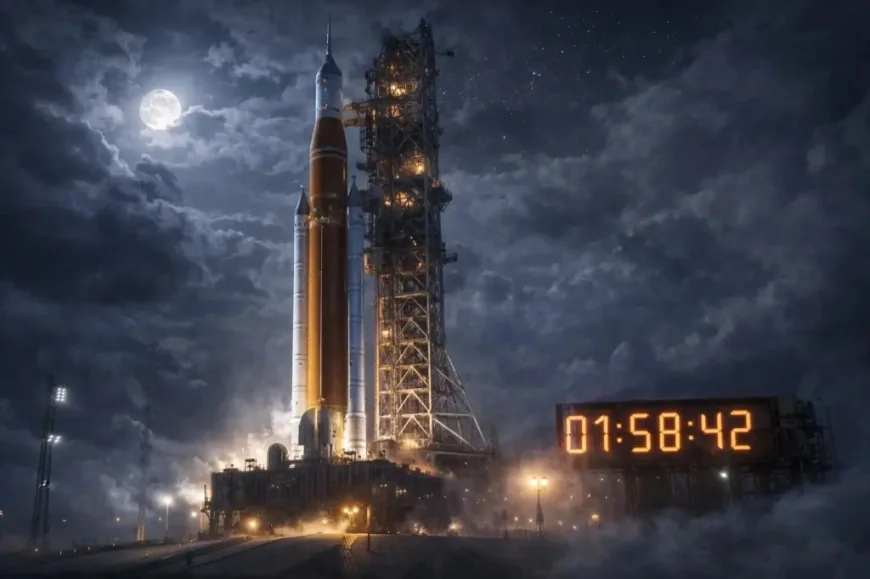
NASA's mega-rocket has been rolled out to the launch pad at Cape Canaveral, Florida, as final preparations begin for the first crewed mission to the Moon in more than 50 years.
Over approximately 12 hours, the 98-meter-tall Space Launch System was moved upright from the Vehicle Assembly Building on a 4-mile (6.5 km) journey to the pad.
Now in place, it will undergo final tests, checks – and a dress rehearsal – before being given the green light for the 10-day Artemis II mission, which will see four astronauts travel around the Moon.
NASA says the rocket could launch as early as February 6, but there are further launch opportunities later that month, as well as in March and April.
The rocket began its journey at 07:04 local time (12:04 GMT) and arrived at Launch Pad 39B at the Kennedy Space Center at 18:41 local time (23:42 GMT).
The rocket was transported by a massive machine called a crawler-transporter, which moved at a top speed of 0.82 mph (1.3 km/h). Live coverage showed the slow-moving spectacle.

NASA said that over the next few days, the rocket will be prepared for a "wet dress rehearsal" – a test of fueling operations and countdown procedures.
The Artemis II crew – NASA's Reid Wiseman, Victor Glover, and Christina Koch, and Canadian astronaut Jeremy Hansen – watched the rocket being moved at the Kennedy Space Center.
In just a few weeks, the four astronauts will be strapped into a spacecraft perched atop the rocket, ready to blast off for the Moon. This will be the first crewed mission to the Moon since Apollo 17 landed on the lunar surface in December 1972.
NASA said the mission could take its astronauts farther into space than ever before.
Artemis II is not scheduled to land on the Moon, but will instead lay the groundwork for future lunar landings, led by the Artemis III mission. NASA said Artemis III will not launch before 2027. However, experts believe 2028 is the earliest possible date.
Koch said seeing the rocket was an incredible feeling.
"On launch day, the astronauts are the calmest people," she said. "And I think... that's because we're completely ready to accomplish the mission we're here for, the one we've trained for."
Hansen said he hopes the mission will inspire the world.
Software Services
 |
Create, launch, and scale your gaming platform — get instant access |
"The Moon is something I've taken for granted. I've seen it my whole life, but then you just glance at it and look away," he said.
"But now I'm looking at it a lot more, and I think other people will join us and look at the Moon a lot more because humans will be flying around the far side of the Moon, and that's great for humanity."
Before Artemis II heads to the Moon, the first two days of their mission will be spent in orbit around the Earth.
"We're going to go almost immediately into an orbit that's 40,000 miles away – about a fifth of the way to the Moon". “We’ll see the Earth from the window like a sphere, something none of us have ever seen from that perspective.
“And then we’ll travel 250,000 miles… We’ll be doing a lot of science and operations along the way.”
When they fly around the far side of the Moon, the crew will have three hours to observe it – to look at it, take pictures, and study its geology, which will help in planning and preparing for future landings at the lunar south pole.
A crucial part of the Orion spacecraft, in which the astronauts will fly, was built in Bremen, Germany.
The European Service Module, which is attached to the back of the crew capsule, is the European Space Agency’s contribution to the mission and was built by Airbus.

“The European Service Module is absolutely essential – without it, we can’t go to the Moon,” says Sian Cleaver, a spacecraft engineer at Airbus.
“It provides the necessary propulsion to get Orion to the Moon.”
She adds that its large solar panels will generate all the power for the craft.
“We also have large tanks of oxygen and nitrogen, which are mixed to create air, and water, so that we can provide the astronauts in the crew module with everything they need to survive during their journey.”
In their cleanroom, the team is busy building more modules for future Artemis missions. Each one takes about 18 months to build, but thousands of engineering hours have gone into designing it. Everything on board has to work perfectly.
“We have to get those astronauts to the Moon and then bring them back completely safely,” says Cleaver.
Now that the rocket is on Launchpad 39B, the Artemis team is working around the clock to prepare it for launch.
The mission has already been delayed by years, and NASA is under pressure to get the astronauts off the ground as soon as possible. However, the US space agency has said it will not compromise on safety.
Thank you for reading this content.
Thank you for reading this content.
What's Your Reaction?
 Like
0
Like
0
 Dislike
0
Dislike
0
 Love
0
Love
0
 Funny
0
Funny
0
 Angry
0
Angry
0
 Sad
0
Sad
0
 Wow
0
Wow
0