
































Bezos Plans 1,000s of Satellites: Blue Origin’s 2027 Space Push
The House Oversight Committee voted to hold Bill and Hillary Clinton in contempt over Epstein subpoenas, sparking outrage and renewed scrutiny.

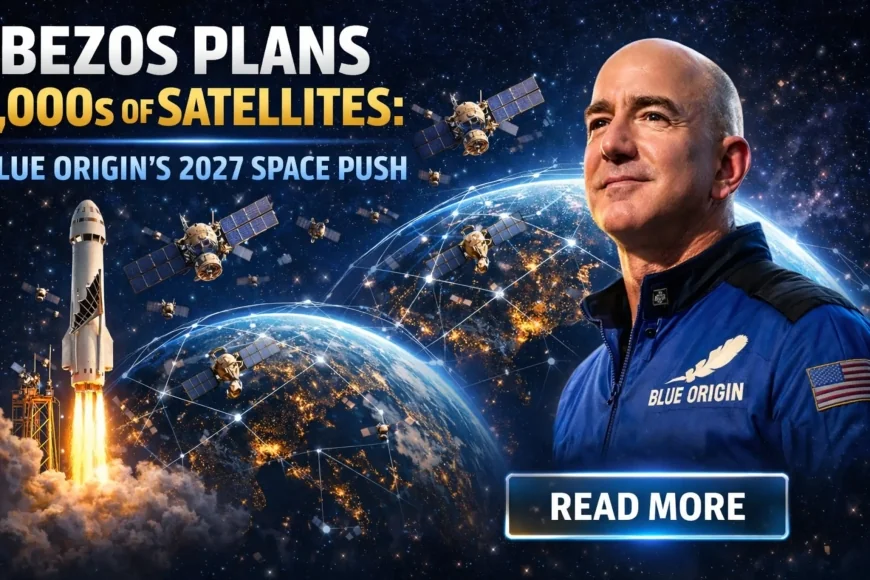
Jeff Bezos's space company Blue Origin announced plans on Wednesday to deploy 5,408 satellites into space for a communications network that will serve data centers, governments, and businesses. With this move, the company enters the satellite constellation market, currently dominated by Elon Musk's SpaceX.
Blue Origin said the satellite deployment is expected to begin in the last quarter of 2027 and stated that the network will be designed to deliver "data speeds of up to 6 Tbps anywhere on Earth." This speed, made possible by the satellites' planned optical communication, is significantly higher than consumer standards and would make the network essential for data processing and large-scale government programs. Blue Origin said the network would be capable of serving up to approximately 100,000 customers.
The announcement of Terran Orbital comes at a time when the space industry is racing to build data centers in space that can meet the growing demand for massive AI data processing, which requires significant energy and resources with the expansion of technology on Earth.

This planned network adds to another satellite constellation associated with Amazon's executive chairman Bezos, which is in the early stages of deploying LEO – a network previously known as Project Kuiper – comprising 3,200 satellites that provide internet access to consumers and businesses.
Musk's Starlink network of nearly 10,000 satellites is at the forefront of the global effort to establish internet infrastructure in space, where clusters of low-orbiting satellites offer greater security and faster connection speeds compared to traditional, single satellites located further out in space. The CEO of SpaceX has said he plans to build data centers in space to support the Starlink network, while Bezos has predicted that such space-based centers will become commonplace in orbit within the next 10 to 20 years.
Starlink, which reports having more than 6 million customers in at least 140 countries, targets individual consumers, businesses, governments, and, with its Starshield variant, U.S. national security agencies. Amazon's Project Kuiper, which currently has 180 satellites in space, has a similar customer strategy.
Software Services
 |
Turn your casino idea into a live platform — start your journey today |
Several Chinese companies are rapidly deploying similar satellite networks to compete with Starlink, which has proven essential for remote communications and geopolitical conflicts. China is developing new reusable rockets that could launch thousands of these satellites at a lower cost in the coming years, a strategy pioneered by Musk's SpaceX and its reusable Falcon 9 rocket. Blue Origin's reusable New Glenn rocket, which has launched twice but has experienced slow development, could be a crucial part of the TerraWave deployment.
According to Blue Origin's statement, unlike Starlink, this planned network will not be for general consumers.
Blue Origin's statement says: "TerraWave enterprise-grade user and gateway terminals can be rapidly deployed worldwide and interface with existing high-capacity infrastructure, providing additional route diversity and increasing overall network resilience," but it is unclear what type of existing infrastructure this network would interface with.
Thank you for reading this content.
Thank you for reading this content.
What's Your Reaction?
 Like
0
Like
0
 Dislike
0
Dislike
0
 Love
0
Love
0
 Funny
0
Funny
0
 Angry
0
Angry
0
 Sad
0
Sad
0
 Wow
0
Wow
0