






























China Reports Record $1tn Trade Surplus Despite Trump Tariffs
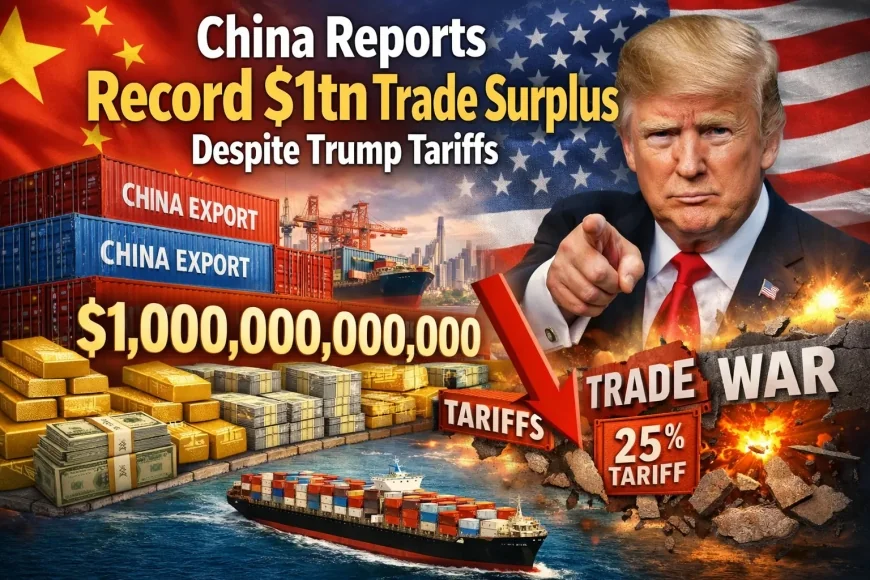
China posts a record $1.19T trade surplus in 2025 despite Trump tariffs, proving export resilience and reshaping the global trade balance.

China announced record export figures for 2025, the year in which US President Donald Trump's tariffs and trade policies roiled the global economy.
Beijing reported on Wednesday the world's largest ever trade surplus – the value of goods and services sold abroad compared to its imports – at $1.19 trillion (£890 billion).
This marks the first time China's full-year trade surplus has exceeded $1 trillion, surpassing the previous record of $993 billion set in 2024.
Last year, China's monthly export surplus exceeded $100 billion seven times – an indication that Trump's tariff campaign had little impact on its overall trade with the rest of the world.
Trade with the US weakened, but this was offset by increased Chinese exports elsewhere, particularly to Southeast Asia, Africa, and Latin America.
Wang Jun, deputy director of China's customs administration, told a press conference on Wednesday that the figures were "extraordinary and hard-won" given the "profound changes" and challenges in global trade.
He cited increased exports of green technologies, artificial intelligence-related products, and robotics.
The massive surplus is due to strong overseas demand for Chinese goods, as trade increased with global partners, including South Asian countries and others in Africa and Europe, coupled with a weak domestic market.
China's economy is grappling with a property crisis and rising debt, making businesses more hesitant to invest and consumers more cautious about spending.
Software Services

Consequently, the need to import goods has decreased, with imports rising by only 0.5%, according to the new figures.
Meanwhile, a weaker yuan, robust supply of goods, and inflation in Western countries have also made Chinese exports more attractive. Deborah Elms, a trade policy analyst at the Hinrich Foundation, said the results were "mixed blessings" for Beijing.
She said China has benefited from increased sales and more jobs created by its overseas businesses, but the pressure to compete with its products in foreign markets could subject its goods to "greater scrutiny."
Elms said China's success is likely to continue into 2026 as Chinese goods and services become even more deeply integrated into global businesses. These latest figures will be seen in Beijing as an indication that China has customers around the world, not just in the US, but Wang warned that China faces an uncertain external environment.
Several countries have expressed concern that their markets are being flooded with low-priced Chinese products with which they cannot compete.
Read Also

Companies are also bracing for another year of turmoil and tariff tensions under the Trump administration.
Last April, Trump roiled the global economy by imposing steep tariffs on goods from more than 90 countries. Some of the harshest tariffs were reserved for China, which exports more to the US than any other country.
The escalating war of words between the world's two largest economies also included threats of triple-digit tariffs.
At the time, trade experts viewed this as a test of China's dependence on the US market, which Beijing insisted was only one of many places where Chinese companies could sell their goods.
Following a meeting between Trump and Chinese leader Xi Jinping in South Korea in October, the two sides managed to de-escalate tensions, averting a complete breakdown in trade relations.
Other more general tariffs remain in place, which have significantly reduced Chinese exports to the US.
Thank you for reading this content.
Thank you for reading this content.
What's Your Reaction?
 Like
0
Like
0
 Dislike
0
Dislike
0
 Love
0
Love
0
 Funny
0
Funny
0
 Angry
0
Angry
0
 Sad
0
Sad
0
 Wow
0
Wow
0