































Japan PM Steps In to Push for More Women’s Toilets in Parliament
Japan’s parliament faces scrutiny as 60 female MPs urge reforms for women’s toilets, highlighting gender equality in Japan and growing female representation.

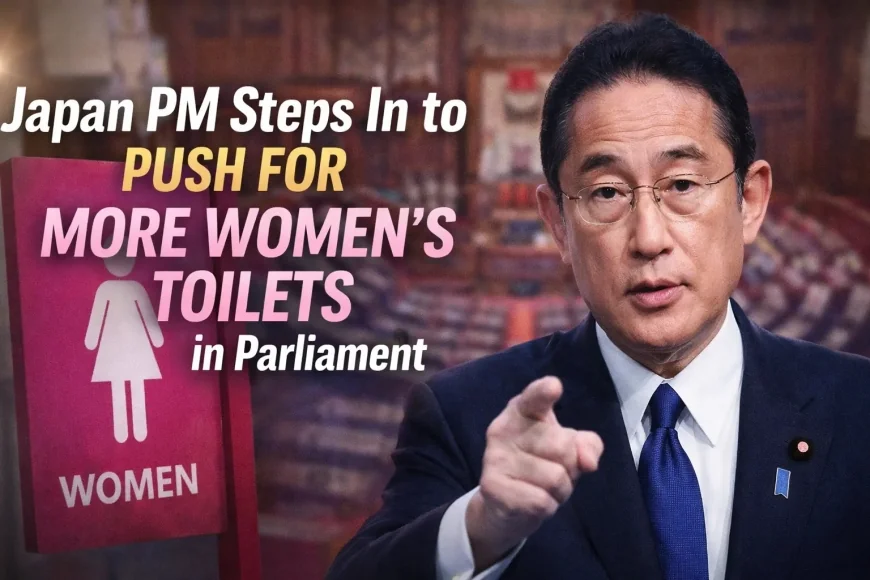
Japanese Prime Minister Sanae Takaichi is among some 60 female lawmakers petitioning for more women's restrooms in the parliament building to accommodate the growing number of female representatives.
A record 73 women were elected to the 465-seat lower house in October 2024, surpassing the previous record of 54 set in 2009.
One opposition lawmaker, Yasuko Komiyama, said that "long lines often form in front of the toilets" before plenary sessions begin, and quoted another lawmaker who said she had given up on trying to use the restroom before sessions started.
There is one women's restroom with two stalls near the plenary session chamber, although there are nine women's restrooms with a total of 22 stalls throughout the entire building.
According to local media reports, there are a total of 12 men's restrooms in the building with 67 stalls and urinals.
Ms. Komiyama of the opposition Constitutional Democratic Party said the current situation is "often inconvenient" because female staff and visitors also use these restrooms.
"I want to raise my voice and prepare for the day when women will hold more than 30% [of parliamentary seats] in the future," she wrote in a Facebook post.
Japan's parliament building was constructed in 1936, a decade before women were granted the right to vote in 1945. The first women were appointed to parliament in 1946.
The parliament building is a massive three-story structure, with a central section rising nine stories high. The building covers an area of 13,356 square meters (143,800 square feet), roughly equivalent to two football fields, with a total floor area of 53,464 square meters.
According to Japanese media, Komiyama said, "If the administration is serious about promoting women's empowerment, I believe we can count on their understanding and cooperation." According to a report in the Asahi Shimbun, Yasukazu Hamada, chairman of the lower house committee, has "expressed a willingness" to consider a proposal for more women's restrooms. The Japanese government had previously set a goal of having women fill 30% of leadership roles across all sectors of society by 2020, but quietly extended that timeframe by a decade at the end of that year.
Software Services
 |
All-in-one casino solution ready to launch — talk to our experts now |
Currently, women hold approximately 16% of the seats in the lower house and about a third in the upper house – 42 out of 125 seats.
Takaichi, who became Japan's first female leader last October, had pledged to increase the representation of women in her cabinet to levels comparable to those of the Nordic countries, which are among the top-ranking nations for female leadership.
Despite this, she appointed only two additional women to her 19-member cabinet.
In Japan, the shortage of women's restrooms is not limited to parliament.
Former Prime Minister Shigeru Ishiba had stated that his government would focus on "improving women's restroom facilities" so that Japan could become a society where "women can live their lives with peace of mind."
Thank you for reading this content.
Thank you for reading this content.
What's Your Reaction?
 Like
0
Like
0
 Dislike
0
Dislike
0
 Love
0
Love
0
 Funny
0
Funny
0
 Angry
0
Angry
0
 Sad
0
Sad
0
 Wow
0
Wow
0