
































Legendary Philosopher Jürgen Habermas Dies at 96
German philosopher Jürgen Habermas, a leading voice of the Frankfurt School and critical theory, dies at 96, leaving a lasting impact on modern philosophy and public debate.

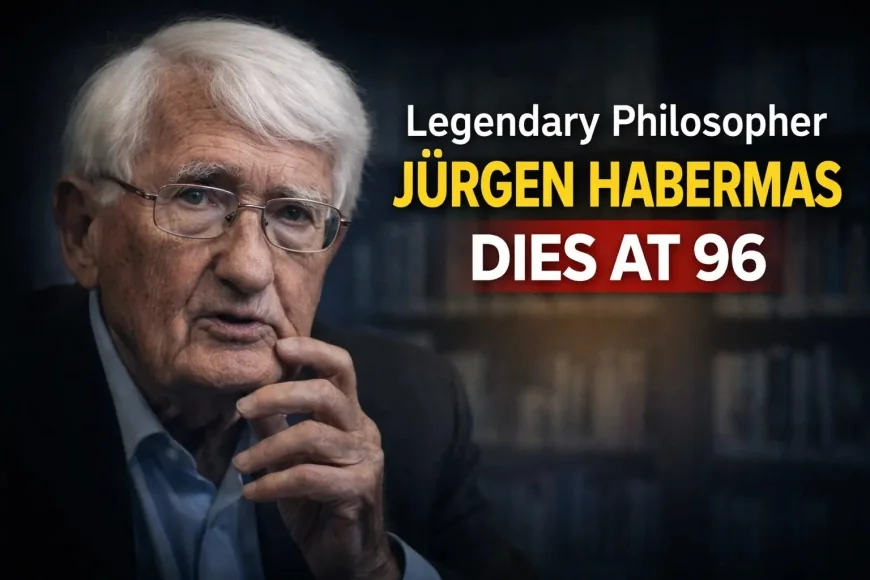
Jürgen Habermas, one of post-war Germany's most influential philosophers and public intellectuals, has passed away at the age of 96.
Habermas, who began teaching philosophy and sociology at the University of Frankfurt in the 1960s, was a vocal supporter of the student protests that swept through West German universities at the time.
He was a prominent member of the "Frankfurt School"—an intellectual group that critiqued capitalism from the perspective of the "New Left," distinct from traditional Marxism.
He was raised in Nazi Germany, and in the 1980s, he engaged in a heated debate with conservative historians who questioned whether the Holocaust was a uniquely German phenomenon.
Habermas's passing was announced on Saturday by his publisher, Suhrkamp.
Read Also

He was born in Düsseldorf in June 1929. His father, who headed the local Chamber of Commerce, had joined the Nazi Party in 1933.
The young Jürgen was enrolled in the "Hitler Youth," although he was too young to fight in the Second World War.
After the war, Habermas studied philosophy and earned a doctorate from the University of Marburg before joining the Institute for Social Research at the University of Frankfurt.
Together with Max Horkheimer and Theodor Adorno, he became a leading proponent of the Frankfurt School.
The school is best known for its "Critical Theory"—which argues that capitalist society, rather than fostering human emancipation, transforms active citizens into passive consumers. Habermas criticized what he viewed as the "commodification" of mass media and entertainment; he argued that mass-produced culture undermines critical public debate.
Software Services
 |
Launch your own casino platform today — get started now |
In 1989–90, he criticized the rapid integration of East Germany into the West; he feared a resurgence of nationalism and expressed his support for a more gradual process.
In the 1990s, Habermas advocated for a unified Europe, which he regarded as the best defense against the resurgence of nationalist rivalries.
His most influential work, *The Theory of Communicative Action*—published in 1981—argues that human societies are sustained not by political or economic power, but by the capacity for rational dialogue. Habermas suffered from a cleft palate from birth, for which he underwent multiple surgeries during his childhood; he later stated that this experience helped shape his thinking regarding language and communication.
Thank you for reading this content.
What's Your Reaction?
 Like
0
Like
0
 Dislike
0
Dislike
0
 Love
0
Love
0
 Funny
0
Funny
0
 Angry
0
Angry
0
 Sad
0
Sad
0
 Wow
0
Wow
0