































Pink and Green Northern Lights Light Up Skies Across the UK
Northern Lights dazzle the UK as a powerful geomagnetic storm paints skies pink and green. See where the Aurora Borealis UK was visible and why it happened.

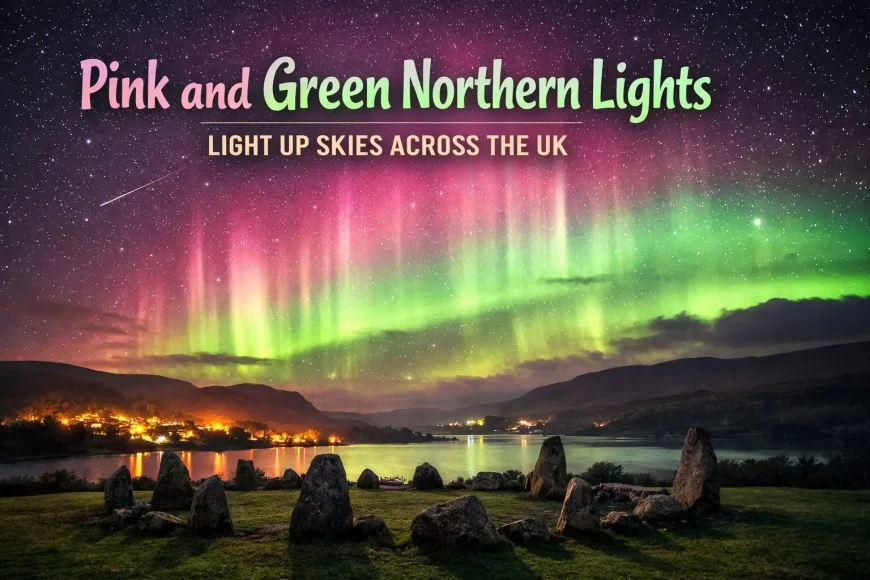
This natural phenomenon – known as the aurora borealis – is the result of particles released from solar flares traveling towards Earth and interacting with particles in the atmosphere.
The Northern Lights are most often seen near the Arctic Circle, but during periods of heightened solar activity, they can be visible in other regions.
Sectacular displays of the lights on Monday evening across Scotland, Northern Ireland and Wales, as well as parts of southwest, southern, eastern and northern England.
Reports suggest the aurora was visible as far south as Veneto and Emilia-Romagna in northern Italy, Murcia in southern Spain, and the Côte d'Azur in southern France.

The aurora forecast for Tuesday night is not as strong, so it is unlikely to extend as far south, and cloud cover is expected across much of the UK.
However, some clear skies are expected in parts of northern and eastern Scotland, and possibly in Northern Ireland early in the night.
Monday's spectacular aurora was the result of a severe geomagnetic storm caused by a coronal mass ejection (CME) – waves of charged particles released from the sun's surface.
Software Services
 |
Start your own gaming platform for just $3,000 |
When they reach Earth, they interact with gases in our atmosphere, creating the colours we see in the night sky. Oxygen atoms glow green, and nitrogen atoms glow red, blue and pink.
We are currently in a period of heightened solar activity known as solar maximum, which occurs during the sun's 21-year cycle. The sun has more sunspots that release CMEs and solar flares – waves of electromagnetic radiation – and therefore we see more auroras on Earth.
Geomagnetic storms and solar flares are perfectly safe for us because we are protected from the radiation by our atmosphere, but they can interfere with technology. The aurora is best seen in a clear sky. First, look for a faint glow towards the north, and if you don't see any colors, try using a camera lens or your phone.
Thank you for reading this content.
Thank you for reading this content.
What's Your Reaction?
 Like
0
Like
0
 Dislike
0
Dislike
0
 Love
0
Love
0
 Funny
0
Funny
0
 Angry
0
Angry
0
 Sad
0
Sad
0
 Wow
0
Wow
0