











Putin and Modi to join forces in Arctic
India is joining forces with Russia in the Arctic Circle where Vladimir Putin is amassing forces, nuclear weapons and attack submarines.

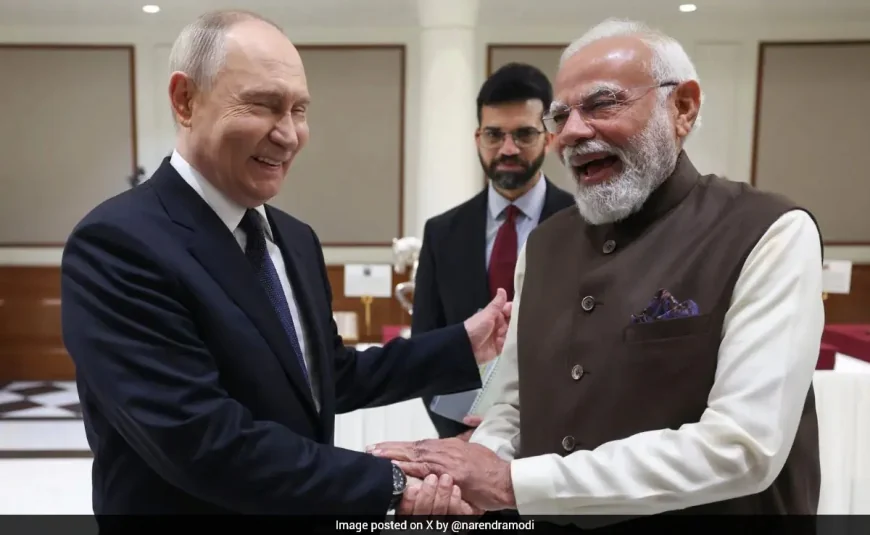
Narendra Modi signed a new military agreement with Putin that will give India access to Russian naval ports in the strategic Arctic Corridor linking Europe and Asia.
Russia will also help train Indian seafarers to operate in polar waters to boost Putin’s alliance in a region expected to be a significant new frontier.
The pair agreed the deal on Putin’s two-day state visit to India where he is seeking to shore up support despite US demands to boycott Russia.
The Russian president said new logistical routes between the two countries were being forged in the Arctic to strengthen their alliance.
Before the state visit, the Russian Duma ratified “Reciprocal Exchange of Logistics Support (Relos)”, a key military agreement granting India access to Russian naval ports along the Northern Sea Route (NSR), the Arctic shortcut between Europe and Asia, from Vladivostok to Murmansk.
The deal approves the transfer of warships, aircraft and forces between Russia and India, securing mutual logistical support.
With his “dear friend” Mr Modi standing beside him, Putin said that co-operation on the NSR, the International North-South Transport Corridor and the Chennai-Vladivostok Maritime Corridor would accelerate under the bilateral agreement.
For over a decade, Russian and Indian strategists have quietly pursued a framework for both countries to co-operate and jointly navigate the fast-melting ice caps of the Arctic.
The move signals an escalation in the battle to seize control of the polar region.
Russia’s prized Northern Fleet and parts of its nuclear stockpile are based in the Kola peninsula and Putin is trying to gain full naval control over the Arctic to block the West from accessing key shipping routes.
For India, it is a chance to strengthen defence and economic ties independently against US pressure.
Officials say Relos will open up new routes stretching from the warm water of Chennai in southern India to the ice edges of the Arctic as New Delhi seeks alternatives to traditional lanes like the Suez Canal.
Indian officials argue the NSR could cut shipping distances between northern Europe and the Indo-Pacific by up to 40 per cent, offering long-term support for supply chains disrupted by geopolitical tensions.
On Thursday, Mr Modi broke protocol to personally receive Putin at the Indian air force’s airport and the two leaders drove together to the prime minister’s residence in New Delhi for a private dinner.
Trade between the countries reached nearly £52bn in 2024-25, though heavily tilted in Russia’s favour, with India’s exports totalling less than £3.7bn.
Moscow has pushed for greater Asian participation in the Arctic after US and European sanctions forced out European and American firms.
China has expanded its footprint in the region and Russia has increasingly encouraged India to follow suit.
New Delhi’s engagement in the Arctic remains modest, but officials say India wants to strengthen connectivity in this region as melting ice enables longer navigation seasons.
Defending the relationship against criticism from Western capitals, Putin said neither country used the partnership “to act against anyone”, emphasising commitment to a multipolar world.
“The India-Russia partnership has been among the steadiest in the contemporary era with a shared commitment to a multipolar world as well to expand the engagement beyond the traditional military, nuclear and space cooperation,” an Indian government spokesman said.
India’s ties with Russia stretch back decades, rooted in Cold War politics and deep cooperation on defence and energy. The visit is Putin’s first since the invasion of Ukraine, and comes as the US continues to pressure New Delhi to stop buying Russian oil.
Before Putin had even landed, reports suggested India had secured a $2bn (£1.5bn) submarine deal with Russia, with delivery expected within two years, officials told Bloomberg.
India became Russia’s largest buyer of seaborne oil after the invasion of Ukraine, though refiners paused new orders last month following fresh US sanctions on the top Russian energy firms.
However, Putin said Moscow would continue “uninterrupted shipments” of fuel to India despite sanctions.
What's Your Reaction?
 Like
0
Like
0
 Dislike
0
Dislike
0
 Love
0
Love
0
 Funny
0
Funny
0
 Angry
0
Angry
0
 Sad
0
Sad
0
 Wow
0
Wow
0