

























US, Switzerland Strike Deal to Cut Tariffs to 15%
Switzerland and the United States have agreed to reduce the steep 39% tariff imposed by President Donald Trump on Swiss imports to 15%.

Switzerland and the United States have agreed to reduce the steep 39% tariff imposed by President Donald Trump on Swiss imports to 15%. This is part of a deal that includes a promise by the Swiss government to invest $200 billion (£150 billion) in the US.
Switzerland's Economics Minister, Guy Parmelin, said, "This is a huge relief for our economy." He noted that the economy has suffered significantly since the additional tariffs were imposed last August.
Parmelin said that the move by Swiss business leaders to meet with Trump at the White House last week proved "decisive" in reaching an agreement.
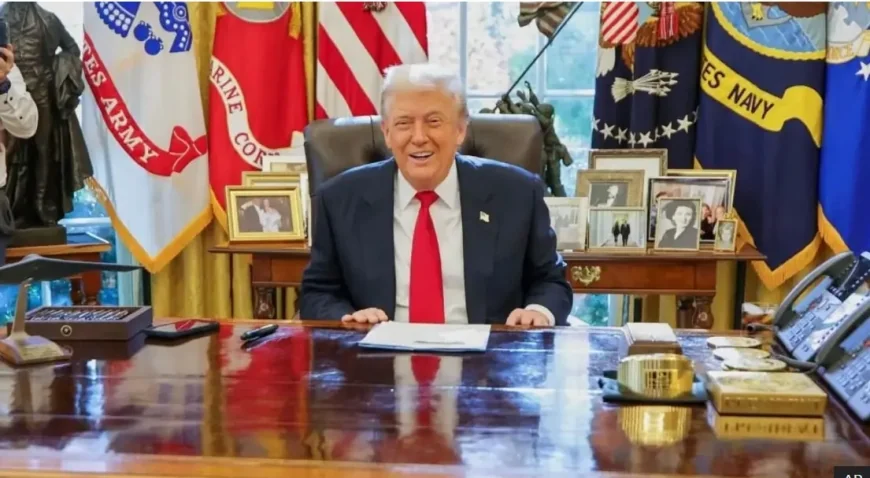
Industry leaders visited the Oval Office and brought gifts, including a Rolex gold watch and a specially engraved gold bar from Swiss gold refining company MKS.
Initial attempts by Swiss President Karin Keller-Sutter to persuade Trump to change his mind went unheeded. Trump said she was "a nice woman, but she didn't want to listen."
But after meeting with Swiss business leaders on November 4, Trump revealed this week that an agreement was underway.
US Trade Representative Jamieson Greer confirmed that an agreement had been reached, saying, "President Trump's unmatched bargaining skills are proving beneficial for the American people."
Chief trade negotiator Helene Büdliger Artieda said the agreement involved hard work. Guy Parmelin said it would bring Switzerland in line with the 15% tariff rate agreed upon by its EU neighbors with the US.
The Economics Minister said this includes $200 billion in direct investment by the Swiss economy into the US by 2028. Under the agreement, one-third of that Swiss money will be invested in the US in 2026.
Switzerland has also agreed to remove tariffs on a quota of US meat exports, including beef, bison, and chicken.
Greer said the agreement "removes long-standing trade barriers" and will create thousands of new jobs through Swiss investment.
For Swiss industry, this agreement couldn't have come sooner. According to the latest data, technology exports to the US are down 14.2% compared to the third quarter of last year—a dramatic decline since the tariff hikes were implemented in August.
The role of Swiss industrialists appears to be significant, and some, especially those trading in luxury goods, gold, or other commodities, were already in contact with Trump.
In September, Trump appeared at the US Open tennis finals in the Rolex VIP box hosted by the Swiss watch company's CEO, Jean-Frederic Dufour.
The president also asked if Trump hadn't imposed such heavy tariffs on Switzerland, would the Rolex CEO have been there?
Last week, Dufour met with Trump again, this time in the Oval Office, accompanied by other business leaders, including Johann Rupert of luxury goods manufacturer Richemont and Marwan Shekarchi of MKS.
A few days after the meeting, Trump was seen in the Oval Office with a watch that looked exactly like a Rolex Datejust. This watch was made by the company as a collectible and is worth thousands of dollars.
It is common these days for visitors to the Oval Office to bring gifts.
British Prime Minister Sir Keir Starmer brought an invitation from King Charles for a lavish state visit. German Chancellor Friedrich Merz presented a framed copy of Trump's German grandfather's birth certificate.
Brendan Smialowski/AFP US President Donald Trump shakes hands with Republican Senator James Risch of Idaho during his inauguration.
The US President receives thousands of gifts each year, which then become US property, stored in the National Archives, and recorded annually by the State Department.
They are later transferred to the Presidential Library. Some gifts can be kept, but if they don't come from a close relative, the President is required to pay federal tax.
Swiss industry is eagerly awaiting this agreement, and several Swiss companies have warned that they will have to lay off employees if nothing changes.
Yves Bugemann, head of the Swiss Watch Industry Federation, welcomed the agreement after months of uncertainty.
Asked about the types of investments the Swiss government could make in the US, which would reach $200 billion, Helene Büdliger Artieda said there was a wide list, including pharmaceuticals. She also mentioned plans by aircraft manufacturer Pilatus to build a large plant in the US and by train manufacturer Stadler to expand its US operations in Utah.
Gold refining is also part of this plan.
"Currently, Switzerland is the primary gold storage location, and New York is the primary trading location," the trade negotiator said.
The chief trade negotiator said these changes could take days or even weeks to come into effect.
The agreement will only become binding once it is approved by the Swiss Parliament, and then put to a referendum.
What's Your Reaction?
 Like
2
Like
2
 Dislike
0
Dislike
0
 Love
0
Love
0
 Funny
0
Funny
0
 Angry
0
Angry
0
 Sad
0
Sad
0
 Wow
0
Wow
0