
































China’s Population Shrinks for 4th Year in a Row
China’s population decline deepens for the fourth year as record-low fertility rates fuel economic fears and strain the ageing population crisis.

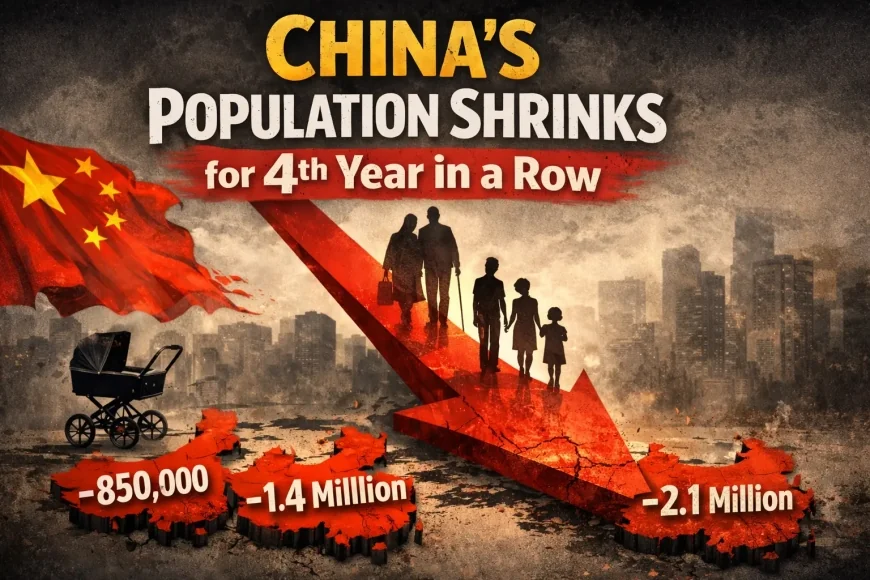
China's population declined for the fourth consecutive year in 2025, as the birth rate hit a record low, despite the government offering a range of incentives to boost it.
According to official data, the country's population shrank by 3.39 million to 1.4 billion by the end of 2025, a faster decline than the previous year.
The birth rate fell to 5.63 per 1,000 people – the lowest since the Communist Party came to power in 1949 – while the death rate rose to 8.04 per 1,000 people, the highest since 1968.
Facing a rapidly aging population and a slowing economy, Beijing is desperately trying to encourage more young people to marry and have children.
In 2016, it scrapped its long-standing one-child policy and replaced it with a two-child limit. When this failed to produce a sustained increase in the birth rate, officials announced in 2021 that they would allow up to three children per couple.

More recently, China has offered parents 3,600 yuan (£375; $500) for each child under the age of three. Some provinces are also offering their own baby bonuses, including additional payments and extended maternity leave.
Some of these incentives have sparked controversy. For example, a new 13% tax on contraceptives – including condoms, birth control pills, and devices – has raised concerns about unwanted pregnancies and HIV rates.
China has one of the world's lowest fertility rates, at around one birth per woman, well below the replacement rate of 2.1. Other economies in the region, such as South Korea, Singapore, and Taiwan, also have similarly low fertility rates. According to a 2024 report by the Youth Population Research Institute in Beijing, China is one of the most expensive countries in which to raise children.
But some Chinese people have indicated that they are deterred by other factors – including the desire to live a carefree life without constantly worrying about their children. “I have very few friends who have children, and if they do, they spend a lot of time thinking about finding the best nannies or getting their children into the best schools,” a Beijing resident said in 2021. “It sounds exhausting.”
Software Services
 |
Turn your casino idea into a live platform — start your journey today |
UN experts believe China’s population decline will continue, estimating that the country will lose more than half of its current population by 2100.
The shrinking population is having economic and social consequences for the world’s second-largest economy: it is exacerbating an already declining workforce and weakening consumer sentiment.
Many young people are moving away from their parents, which is also increasing the number of elderly people who have to care for themselves or rely on government payments.
But according to the state-run Chinese Academy of Social Sciences, pension funds are running out – and the country is running out of time to build up sufficient funds to care for its growing elderly population.
Thank you for reading this content.
What's Your Reaction?
 Like
0
Like
0
 Dislike
0
Dislike
0
 Love
0
Love
0
 Funny
0
Funny
0
 Angry
0
Angry
0
 Sad
0
Sad
0
 Wow
0
Wow
0