
















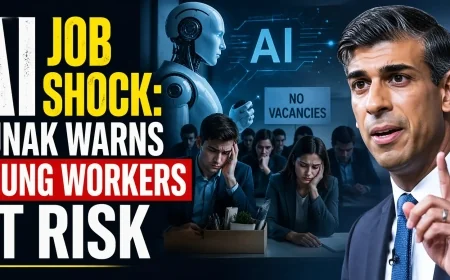















Replacing Junior Staff with AI Could Trigger a Talent Crisis
Companies are increasingly replacing junior staff with AI, cutting internships and entry-level roles


As more and more companies brazenly announce AI-based layoffs in 2025, junior and entry-level jobs are the first to be eliminated.
Graduate programs and internships are at risk of becoming a thing of the past as large companies cut staff to implement AI. Recently, Amazon laid off 14,000 corporate employees as it aims to invest in its "biggest bets," including generative AI.
Other companies relying on AI and shedding jobs include Accenture, Salesforce, Lufthansa, and Duolingo.
Now, concerns are growing about whether AI can replace the jobs of entry-level employees and graduates, raising barriers to entry.
In fact, 62% of UK employers fear that junior, clerical, managerial, and administrative positions will likely be lost to AI, according to a new survey of 2,019 senior human resources professionals and decision-makers by the Chartered Institute of Personnel and Development (CIPD).
Further data shows that the number of available graduate positions has declined over the past year. According to data from labor research firm Revelio Labs, postings for entry-level jobs in the US have fallen by approximately 35% through January 2023.
In the UK, the Student Employer Institute found in its annual student recruitment survey that 1.2 million applications were received for approximately 17,000 graduate positions in the UK, reflecting intense competition and limited positions available for young people.
As companies are cutting back on junior staff recruitment, Fabian Stephany, an assistant professor of AI at the Oxford Internet Institute, explained that hiring entry-level employees is actually an "investment" in the future.
Although they make mistakes and require hands-on training, experts told CNBC that using AI to replace junior employees will only harm companies in the long run.
'Future Leadership'
According to Chris Eldridge, UK and North America CEO of tech recruitment firm Robert Walters, healthy organizations develop their own talent, and it's not feasible to hire externally for all positions.
"If you eliminate too many junior roles, you could deplete the internal talent pipeline," Eldridge said.
"Entry-level, junior-level roles are the breeding ground for future leadership. I think if you reduce that junior level, the business will eventually run out of talent, which will increase recruitment costs."
If a company doesn't have enough young talent, it will be forced to hire from outside in the future, creating a "talent destruction cycle," resulting in increased costs, higher salaries, and dependence on the external talent market.
Aldridge said, "I represent a talent consultancy; however, we would advise every organization to have multiple ways to access talent in the market, and one of them is to create your own."
He added, "Retaining talent through training, development, and opportunities is also very important... But if you stop bringing junior or entry-level talent into an organization, you miss out on a crucial aspect of development."
'Generational Bridge'
According to Stephanie of the Oxford Internet Institute, companies that don't nurture young talent will eventually lose touch with consumers and mainstream culture.
Stephanie told Make It, "A company is part of society, and if it doesn't adequately reflect society, then it's very difficult for me to imagine a business model or product that doesn't require this generational bridge... and young people bring new ideas that bring a fresh perspective."
Stephanie said that companies that fail to adapt and hire junior employees will become like "an old-age company." "It's like a company of people who are retiring soon because... they may not have the edge and passion needed to bring a new product to market."
Eldridge agreed, saying that while there's a common perception that all good ideas come from the top, "a significant percentage of good ideas in a company come from people who see it with a new perspective within their first two or three years in the organization."
An additional benefit of having young people in an organization is the opportunity for reverse mentoring, especially because young people bring valuable technology knowledge, and losing this would be a "real threat" to organizations.
He said, "If anything reduces this opportunity for two-way mentorship and knowledge transfer, it will lead to a loss of institutional knowledge or create institutional gaps."
Cloudflare co-founder and CEO Matthew Prince told "Worldwide Exchange" last week that the technology company plans to hire 11,000 interns to help upskill the next generation and bring new ideas to the AI era.
What's Your Reaction?
 Like
0
Like
0
 Dislike
0
Dislike
0
 Love
0
Love
0
 Funny
0
Funny
0
 Angry
0
Angry
0
 Sad
0
Sad
0
 Wow
0
Wow
0