



















Trump Defends Witkoff After Russia Leak
US President Donald Trump has defended Special Envoy Steve Witkoff, saying he was doing "normal business"

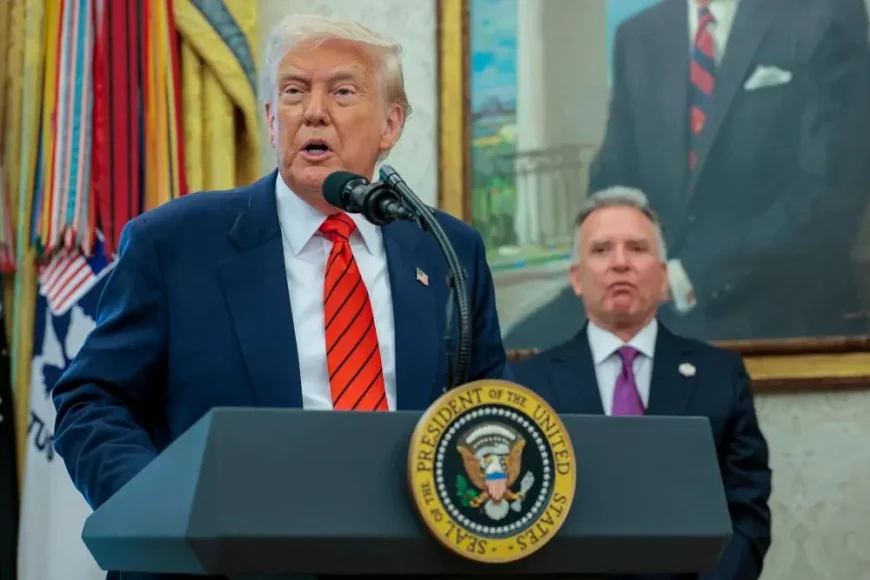
US President Donald Trump has defended Special Envoy Steve Witkoff, saying he was doing "normal business"after a leaked recording appeared to show him advising a Russian official on how to appeal to the president.
Trump told reporters on Wednesday that he had not heard the audio, but that Witkoff was "doing what a dealmaker does" to "sell" a peace plan to both Russia and Ukraine.
The leaked call from last month surfaced just days after the US presented a 28-point peace plan that largely reflected Russia's position on Russia's massive war in Ukraine.
Witkoff has visited Moscow several times this year and will meet with Russian President Vladimir Putin again next week.
He has never visited Kyiv in his role as Special Envoy, although other US officials have, and US Army Secretary Dan Driscoll visited Kyiv this week, and Trump says he will engage with the Ukrainians further.
Diplomatic talks have continued despite criticism by Ukrainian and European leaders of the initial draft plan for being too favorable to Russia. The proposals included handing over Ukrainian-controlled territory in eastern Ukraine to Russia.
The plan has since been revised to better reflect Ukraine's interests and the views of European allies. Ukrainian President Volodymyr Zelensky has stated that he is willing to meet with Trump to discuss remaining "sensitive points."
In a leaked audio recording obtained by Bloomberg and shared as a transcript, Vitkov is heard advising Putin's foreign policy adviser, Yuri Ushakov, on how to get on Trump's good side.
During the leaked conversation, the two men reportedly discussed ending the war, with Ushakov asking if it would be beneficial to arrange a meeting with his bosses – Putin and Trump.
Witkoff is quoted as saying, "My man is ready to do it," before suggesting how to approach the call.
Witkoff is quoted as saying, "Just reiterating that you congratulate President [Trump] on this success... that you respect that he's a man of peace and that you're just, you're very happy to see this happen." "I think that's going to make this a really good call."
According to the transcript, Witkoff continues, "I told the President that you—that the Russian Federation has always wanted a peace deal. That's what I believe." "The issue is that we have two countries that are having a hard time reaching a compromise."
Witkoff adds, "I'm even thinking that maybe we should put forward a 20-point peace proposal, just like in Gaza."
The call ends with Witkoff informing Ushakov about Zelensky's upcoming visit to the White House and saying that "if possible," Trump and Putin should speak before that meeting.
This followed a two-and-a-half-hour phone conversation between the US and Russian presidents, news of which surfaced when Zelensky was visiting Washington last month.
Before the Trump-Putin call, the US president seemed to be running out of patience with his Russian counterpart and suggested he might supply Ukraine with long-range Tomahawk missiles.
By the time Zelensky arrived at the White House, the mood seemed to have changed. Trump said that providing Tomahawks to Kyiv could escalate the conflict and that he believed Putin "wants to end the war."
When asked about the leaked call, Yuri Ushakov told Russian state media that it was "probably meant to be disruptive" and that it was "unlikely" to improve relations.
He also confirmed that Witkoff would travel to Moscow next week in accordance with a "preliminary agreement."
It was unclear who was behind the leak, but Bloomberg also transcribed another alleged call between Ushakov and Putin's envoy, Kirill Dmitriev, who spent several days with Witkoff in Miami in late October, a few weeks before the 28-point draft plan was revealed.
According to the transcript, Dmitriev tells his Russian colleague: "We'll just create this paper with our opinions, and I'll forward it informally, making it clear that it's all informal. And let them do their own thing."
Clearly angered by the report, Dmitriev complained of a "well-funded, well-organized malicious media machine" designed to spread falsehoods, discredit opponents, and confuse the public.
What's Your Reaction?
 Like
0
Like
0
 Dislike
0
Dislike
0
 Love
0
Love
0
 Funny
0
Funny
0
 Angry
0
Angry
0
 Sad
0
Sad
0
 Wow
0
Wow
0