










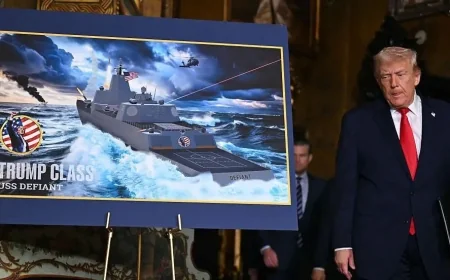






Trump’s 2026 State of the Union: 7 Explosive Moments
From Supreme Court tension to a Democrat’s removal, here are 7 explosive moments from Donald Trump’s 2026 State of the Union speech.

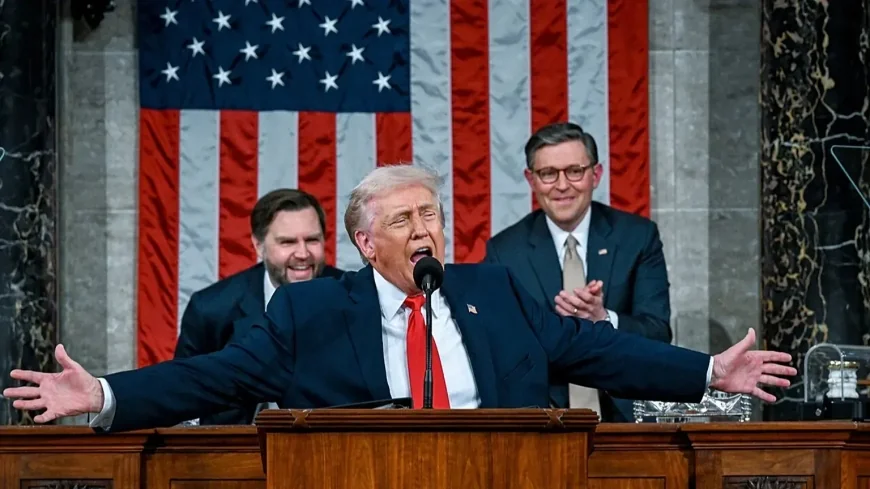
President Donald Trump delivered an update on America as part of his State of the Union address.
In the longest address of its kind to date, Trump delivered triumphant—and sometimes aggressive—remarks, praising the work of fellow Republicans, and outlining his future agenda.
The president's annual address is delivered to members of the US Congress, his Cabinet, members of the Supreme Court—as well as the president's family and other guests.
The speech came at a particularly crucial time for the president, with tensions rising in Iran, the nation's highest court striking down his global tariffs, and persistent concerns about affordability in the US—an issue that could contribute to his losing full control of the US Congress in the midterm elections later this year.
Here are some of the highlights of his evening, as he spoke to Congress and a deeply divided audience of millions of Americans.
1. All Eyes (Half-Missing) on the Supreme Court
This was the first time Trump—at least publicly—came into contact with members of the Supreme Court since he criticized them for their decision to lift global tariffs.
Read Also
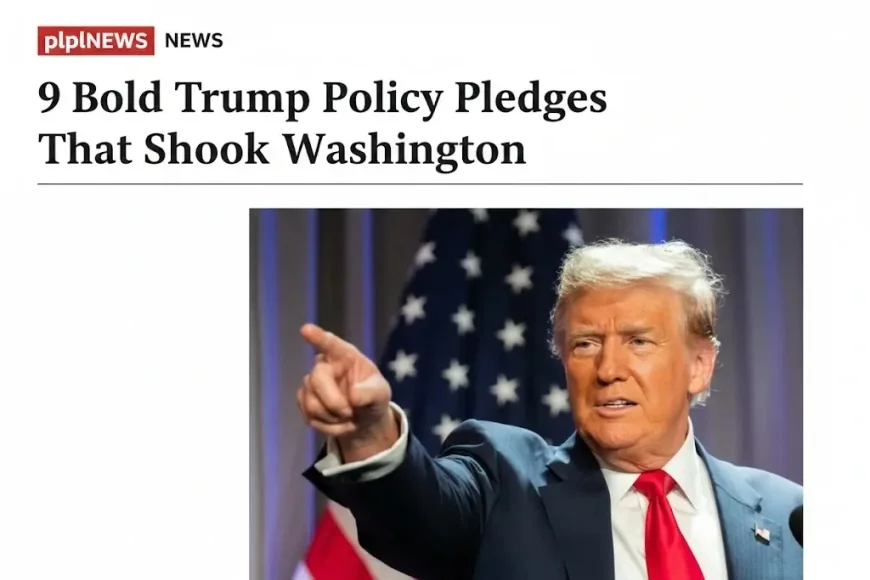
Typically, the entire court is present for the president's State of the Union address, but on Tuesday, only four of the nine were present: Chief Justice John Roberts and Justices Amy Coney Barrett, Elena Kagan, and Brett Kavanaugh.
When Trump entered the room, he shook hands with individual lawmakers and then approached the justices seated in the front row. As is customary, Trump shook Roberts' hand as he approached the podium, but both had calm faces—perhaps a sign of the tension that had been building since the president criticized the six justices, including Roberts, who had ruled against Levy.
Later, when Trump directly mentioned that decision and his tariff policy in his speech, he again rebuked the judges, though not as harshly as before. The camera in the room focused on Justice Amy Coney Barrett—whom Trump nominated during his first term and who also ruled against his tariffs.
When Trump called the decision "disappointing" and "unfortunate," she remained expressionless, gazing at the judges sitting just a few feet away from him in the front row of the chamber.
Trump further stated that he would resort to other legislation to pursue his tariff policy—including a new 15% tariff, which he announced would replace the tariffs struck down by the High Court.
This new tariff was imposed by a proclamation signed by Trump, a never-before-used law known as Section 122, which gives Trump the power to impose tariffs of up to 15% for 150 days, after which Congress must intervene.
Software Services
 |
Create, launch, and scale your gaming platform — get instant access |
On Tuesday, Trump later stated that "congressional action will not be necessary," saying the tariffs would replace the income tax, and hinting at what some have worried might not comply with the law.
2. Democrats Kicked Out of the Room - Again
Protests from the opposing party at the president's annual address have become almost commonplace.
Dozens of Democrats, including some in the leadership, stayed out of Trump's speech and instead attended rallies in Washington to protest the president and his agenda.
Inside the chamber, the lack of Democrats was clearly visible on one side, with many camera angles showing rows of empty seats.
The few Democrats remaining in the room also registered their opposition.
Congressman Al Green of Texas was ejected from the chamber for the second consecutive year. As Trump entered the chamber, Greene displayed a white sign that read, in black letters, "Black people are not monkeys!"
The sign appeared to be a reference to a racist video Trump posted on social media and later deleted, which depicted former President Barack Obama and former First Lady Michelle Obama as monkeys.
Read Also
The sign and the lawmaker's shouting prompted several officers to escort him out of the chamber. Last year, during Trump's speech, Greene was also ejected after shouting.
Congresswoman Ilhan Omar, a Democrat from Minnesota, was also heard repeatedly yelling at the president when he mentioned immigration and alleged fraud in Minnesota's Somali-American communities.
"That's a lie, you're a liar," Omar yelled as Trump spoke over her.
3. Politics and Patriotism?
In a movie-like entry, the US men's hockey team descended into the House chamber from an overhang where members of the press were seated above Trump.
Those in the audience erupted in applause and chanted "U-S-A."
The team's arrival was teased this week after winning the gold medal in overtime against Canada at the Winter Olympics on Sunday.
Read Also
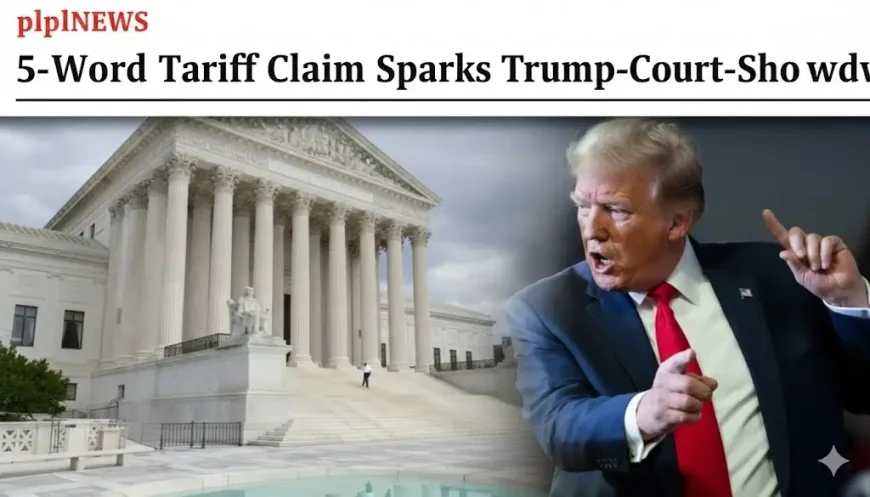
Trump applauded the team's victory as he looked out at the chamber with a gold medal in his hand and announced that the team's goaltender, Connor Hellebuyck, would receive the Presidential Medal of Freedom, the highest civilian honor.
Thank you for reading this content.
Patriotism was a key theme of Trump's speech, in which he mentioned the celebrations planned for the country's 250th anniversary this summer. But he also used these issues to highlight divisions within the country.
At one point, he asked those in the audience—mostly members of Congress—whether they agreed with the statement: "The first duty of the American government is to protect American citizens, not illegal aliens."
Cameras rolled across the room, and Republicans stood and cheered, while the other half of the room remained motionless.
Trump repeatedly mentioned that Democrats were not cheering or standing while he listed his administration's actions and policy victories.
At one point, he said of Democrats, "These people are crazy. I'm telling you. They're crazy."
Thank you for reading this content.
What's Your Reaction?
 Like
0
Like
0
 Dislike
0
Dislike
0
 Love
0
Love
0
 Funny
0
Funny
0
 Angry
0
Angry
0
 Sad
0
Sad
0
 Wow
0
Wow
0