
































UK Weather: Beast from the East Chances
A weather phenomenon known for bringing bitterly cold weather to northern Europe could be unfolding in the stratosphere, forecasters have said.

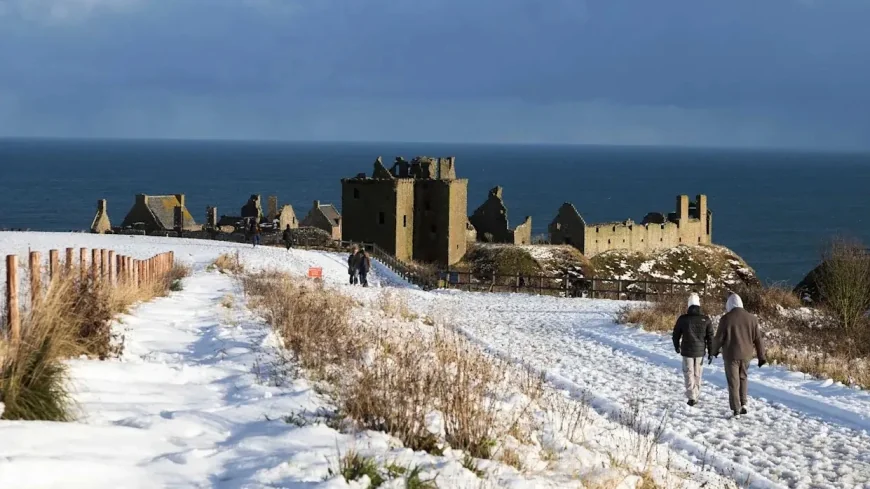
The Met Office has stated that a weather event with the potential to bring the "Beast from the East" to Britain may already be underway.
This follows a cold front earlier this week that brought Arctic air masses from Siberia to Britain, and temperatures in one area of Scotland reached -12.6 degrees Celsius on Thursday night.
Conditions may improve somewhat over the weekend, but forecasters have warned that another cold snap could occur due to a specific weather event.
The Met Office told Yahoo News that "there are indications that a minor sudden stratospheric warming (SSW) event is underway," adding that "it is still too early in the winter season for this to occur."
This is the same phenomenon responsible for the Beast from the East that affected Britain, Ireland, and much of continental Europe in 2018.
What is sudden stratospheric warming?
Sudden stratospheric warming, or SSW, refers to the rapid warming of air in the stratosphere, occurring between 10 km and 50 km in altitude.
The Meteorological Department says this phenomenon can cause temperatures to rise by 50°C in a matter of days. This warming occurs so far above the Earth's surface that we don't notice it ourselves, but it affects the weather around us.
The forecasting service explains that every winter, strong westerly winds blow in the stratosphere above the Arctic, called the stratospheric polar vortex.
Every few years, these winds weaken for a while, or change direction, blowing from east to west. Then, cold air rapidly descends into the vortex, causing the stratospheric temperature to rise rapidly.
The Met Office explains, "The waves from our weather fluctuations travel through the atmosphere to the easterlies in the stratosphere, where they no longer travel further, but instead break up the easterlies and strengthen them, causing them to descend."
As this cold air spreads, it can affect the movement of the jet stream, which impacts our weather. It pushes it further south, creating higher pressure in the North Atlantic, which blocks the flow of mild Atlantic air and draws cold air from the continent.
How does this affect UK weather?
Depending on where you are in the world, SSW events can have different effects on the weather.
The Met Office explains, "The sudden increase in heat in the stratosphere can sometimes cause the jet stream to become more 'snake-like,' creating a large area of high pressure."
Typically, this high pressure will form over the North Atlantic and Scandinavia, meaning that Northern Europe, including the UK, is more likely to experience prolonged dry and cold weather.
Meanwhile, this phenomenon brings mild, wet, and windy weather to Southern Europe.
On the borders of these regions, cold easterly winds blow, and in some cases, temperatures drop significantly, leading to snowfall, as was seen during the so-called "Beast from the East" that hit Europe in early 2018.
How likely is a Beast from the East?
First, it's important to note that SSW events don't occur every year and don't always impact our weather.
However, the Met Office says that when these events do occur, they "often lead to cold snaps," meaning they greatly increase the risk of winter weather.
In a statement to Yahoo News, the Met Office said: "There are indications that a minor sudden stratospheric warming (SSW) event is occurring.
"Although SSW events can occur in November, it is still too early in the winter season for this to be the case."
The Met Office said that the effects of SSWs typically take about 10 days to three weeks to propagate downward into the troposphere and impact our weather.
"This means that the effects will not be expected until early to mid-December, and therefore it is too early to provide definitive information about the potential impact on the UK at this time," it added.
"Although this may signal a cold start to winter, some SSWs have little or no impact on UK weather; For example, we saw a minor SSW in 2019 which had little impact on our weather. "Around 70% of major SSWs are followed by cold conditions and easterly winds across northern Europe, including the UK, but not all events result in extreme cold or snowfall."
What's Your Reaction?
 Like
0
Like
0
 Dislike
0
Dislike
0
 Love
0
Love
0
 Funny
0
Funny
0
 Angry
0
Angry
0
 Sad
0
Sad
0
 Wow
0
Wow
0