































Dundee and US Surgeons Perform World’s First Robotic Stroke Surgery
Doctors in Scotland and the US have completed the world's first stroke procedure using a robot.

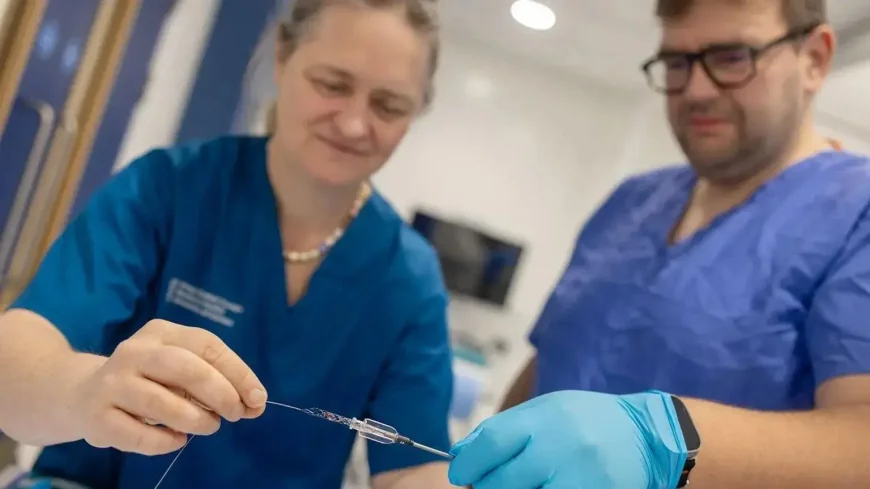
Professor Iris Grunwald of the University of Dundee performed a remote thrombectomy – a procedure to remove blood clots after a stroke – on a human cadaver donated to medical science.
Professor Grunwald was at Ninewells Hospital in Dundee, while the body she was operating on using the machine was at the university on the other side of the city.
A few hours later, neurosurgeon Ricardo Hanel in Florida used the technology to perform the first transatlantic surgery on a human body in Dundee, more than 4,000 miles (6,400km) from his base in Jacksonville.
The team has called it a potential "game changer" if it is approved for use on patients.
Doctors believe the technology could transform stroke care, as delays in accessing specialist treatment can directly impact recovery prospects. Professor Grunwald said: "It felt like we were witnessing the first glimpse of the future.
"Where previously this was considered science fiction, we have shown that every step of the procedure can already be done."
The University of Dundee is a global training centre for the World Federation for Interventional Stroke Treatment, and it is the only place in the UK where doctors can operate on cadavers with a fluid similar to human blood circulating through the veins.
Professor Grunwald said: "This was the first time we were able to perform the entire mechanical thrombectomy procedure on a real human body to demonstrate that all steps of the procedure are possible."
Juliet Bouverie, chief executive of the Stroke Association charity, told BBC News that the transatlantic procedure was "a fantastic innovation".
She added: "For too long, people living in remote and rural areas have been denied access to thrombectomy.
"This kind of robotics could address the inequality that exists in stroke treatment in the UK."
In this experiment, a fluid similar to human blood was used in four different cadavers.
The people who donated their bodies to science had died within the last three years and were then embalmed.
Both the Dundee and Florida procedures were carried out last month using robotics from the Lithuanian firm Sentante. While remote thrombectomy has previously been performed on silicone models, 3D printed replicas and animals, this is believed to be the first procedure performed on a human body.
The team now hopes to participate in clinical trials next year.
How does the technology work?
An ischaemic stroke occurs when an artery is blocked by a clot. This cuts off the supply of blood and oxygen to the brain, causing brain cells to stop functioning and die.
The best treatment is thrombectomy, in which a specialist uses catheters and wires to remove the clot.
But what happens when a patient doesn't have access to a specialist who can perform this procedure?
Professor Grunwald said the experiment showed that a robot could be connected to the same catheters and wires typically used by a surgeon, and the medical staff with the patient could simply connect the wires.
The surgeon, from another location, could then manipulate their wires, and the robot would perform the exact same movements on the patient in real time to carry out the thrombectomy.
The patient would be in the hospital operating room, while the doctor could perform the procedure from anywhere – even their home – using the remote control machine.
Professor Grunwald and Ricardo Henel were able to view live X-rays of the body during the experiment and monitor the progress in real time, and the Dundee expert said it only took 20 minutes of training.
Tech giants Nvidia and Ericsson were involved in the project to ensure the robot's connectivity.
What's Your Reaction?
 Like
0
Like
0
 Dislike
0
Dislike
0
 Love
0
Love
0
 Funny
0
Funny
0
 Angry
0
Angry
0
 Sad
0
Sad
0
 Wow
0
Wow
0