
































Luxury Brands See Shoppers Return in China
Luxury brands say Chinese shoppers are slowly returning after months of weak demand.

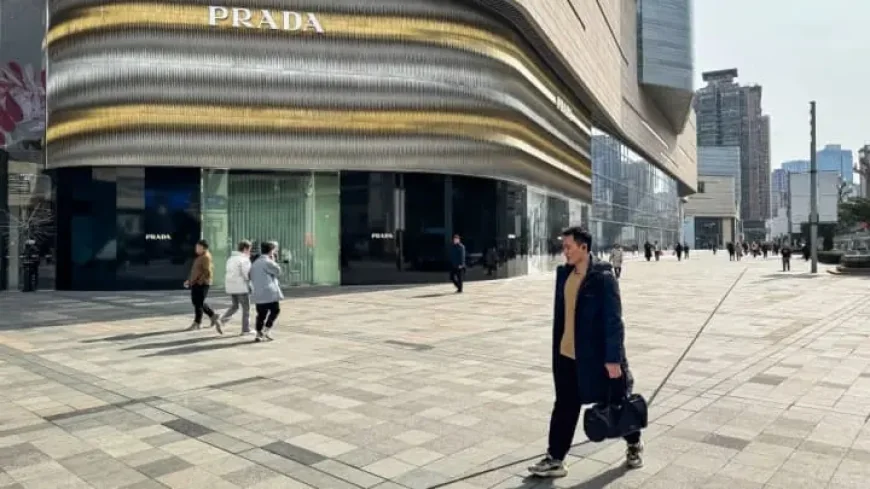
China was on track to become the world's largest luxury market during the coronavirus pandemic, but the sector has since slowed sharply. High youth unemployment, a prolonged property slowdown, and weak domestic confidence have put pressure on discretionary purchases, especially among middle-income buyers.
Speaking to Charlotte Reed at the JPMorgan Global Luxury & Brands Conference in Paris, France, executives said they are beginning to see a shift in spending patterns. Prada Group Chief Financial Officer Andrea Bonini said the company is "cautiously optimistic."
"We're actually seeing things stabilize," Bonini explained, adding that "structural trends in this industry are still present, and they're also present in China."
Prada's CFO said that a more "normal" situation could emerge only in 2026 after the rapid ups and downs following the pandemic.
Coach is also seeing strong growth. CEO and Brand President Todd Khan told CNBC: "We had a fantastic quarter. Our China business grew 20%," he said, adding that this trend has been ongoing for several quarters. He said Coach's position has helped attract more cautious consumers. He added: "Our preferred region in China, especially if the consumer is more cautious, really impresses."
The company is strengthening its ground presence with 25 years of experience in the market, a co-design studio in China, and expansion into regional hubs like Wuhan. Coach has also been somewhat shielded from US tariffs.
Khan said, "So, 40% of our growth is international. So, internationally, the US tariffs you're referring to have no impact."
Recent earnings support this view. UBS research shows that Burberry's sales in Greater China rose 3% last quarter, exceeding expectations for steady growth, while Richemont said sales to Chinese customers remained "almost stable"—a significant improvement from previous double-digit declines. UBS further stated that Richemont recorded 10% growth in the Asia-Pacific region and saw improvement by the end of the year.
LVMH, for its part, has pointed to early signs of stability. Last month, the luxury giant reported 1% growth in the third quarter—its first quarterly growth this year—according to Reuters, with CFO Cécile Cabanis telling analysts that "Mainland China remained positive in the third quarter."
Still, analysts caution against expecting a complete recovery.
JPMorgan's European luxury head, Chiara Battistini, told CNBC that "it's too early to call this a turnaround or a complete turnaround," noting that the apparent improvement occurred despite a "particularly easy" comparative base. She said a large part of this increase reflects spending being repatriated to mainland China rather than a broad-based uptick.
Battistini said the overall picture of the "total Chinese consumer" in Asia remained "more mixed," while the broader backdrop for China remained "quite complex."
Brands in the Race for Localization
Global brands are being driven to localize more aggressively as competition from Chinese brands intensifies. As CNBC's Evelyn Cheng reported a few weeks ago, many brands are increasing China-focused marketing—in some cases to over 40% of revenue, as WPIC's Jacob Cook reported—as well as accelerating product cycles and developing designs using local consumer data.
The rise of social media platforms Xiaohongshu and Douyin has also forced companies to rethink their content and product strategies.
This shift is gradually reaching retailers and large luxury companies, which are seeing modest growth in this area. Outlet operator Value Retail has also seen good progress. Chairman Scott Malkin said the company's China-based properties are "doing very well right now," and explained that global brands have encouraged the company to expand in China to ensure "the correct presentation of real surplus."
Malkin said the outlets are attracting "aspirational shoppers who will become full-price customers again in a new era."
The same is true for eyewear group EssilorLuxottica, which is experiencing broad-based growth. CFO Stefano Grassi said: "Our sales were double-digit in North America, double-digit in Europe, and double-digit in Asia."
"We see consumers not going down. We see consumers being attracted by product innovation," Grassi said. Luxury sector leaders agree that China is stabilizing, but not yet back on track.
What's Your Reaction?
 Like
0
Like
0
 Dislike
0
Dislike
0
 Love
0
Love
0
 Funny
0
Funny
0
 Angry
0
Angry
0
 Sad
0
Sad
0
 Wow
0
Wow
0