














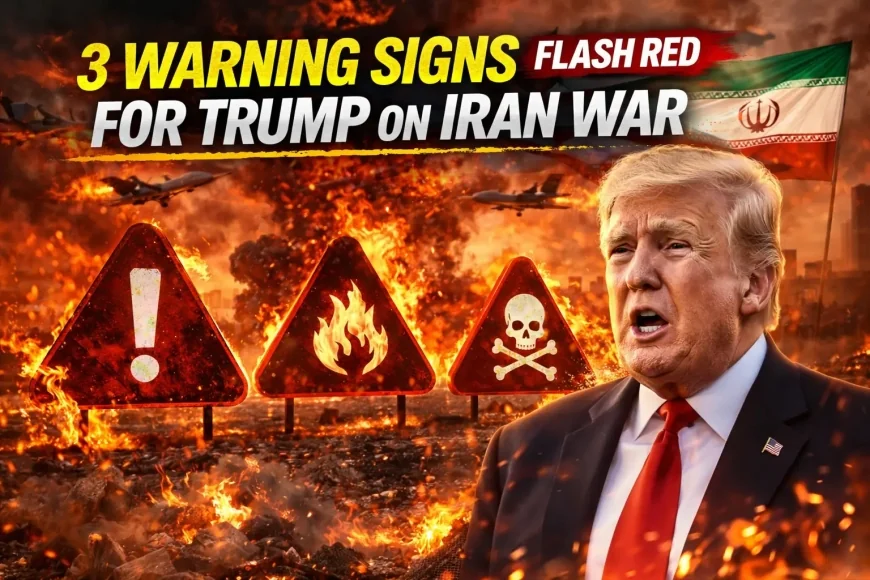
3 Warning Signs Flash Red for Trump on Iran War
Trump’s approval drops as gas prices surge and economic fears rise during the Iran war, signaling trouble ahead of key elections.

Since returning to the White House last January, President Donald Trump's popularity among the American public has been steadily declining.
While this is somewhat common for U.S. presidents serving a second term, the initial dip in Trump's popularity also reflects ongoing public discontent regarding rising prices and the cost of living—issues that played a pivotal role in securing victories for Democrats in several elections over the past year.
According to data from the election analysis website 'The Downballot,' the performance of Democrats in special elections held in 2025 was, on average, 13% better in those same constituencies compared to the 2024 presidential election.
The ongoing war in Iran has further exacerbated these economic concerns.
A survey conducted by the polling firm 'Ipsos' found that, at the beginning of his second term, 43% of the American public approved of Trump's handling of the economy. By June 23, 2025, this figure had dropped to 35% and remained hovering around that level for the remainder of the year.
Three weeks into the war with Iran, gas prices have surged to an average of approximately $4 per gallon, as illustrated in the chart below.
Meanwhile, Trump's economic approval rating has plummeted to 29%.
This figure falls below any level recorded by Joe Biden during his four-year tenure in the White House—a period during which Americans were grappling with severe inflation in the wake of the COVID-19 pandemic.
Economic anxieties contributed to the Democrats' defeat in the 2024 elections, resulting in the Republican Party maintaining control over both the presidency and both chambers of Congress for the past year. Now, it appears that these very same economic concerns are weighing heavily on Trump's overall net approval rating. According to an average of polls conducted by political analyst Nate Silver, Trump's approval rating stood at 52% at the beginning of his second term.
However, while this was not the kind of "political honeymoon" (a period of initial popularity) that many previous presidents have enjoyed, securing the support of most Americans following a highly contested election nevertheless provided Trump with the opportunity to assert his electoral mandate and advance his broad political agenda—including issues such as immigration, tariffs, cuts in government spending, and tax reform.
Yet, by February 28—as the war with Iran was getting underway—only 42% of Americans held a positive opinion of the President. This week, that figure has dropped even further to 40%, as illustrated in the chart below.
Software Services

With only seven months remaining until the congressional midterm elections, this situation is considered extremely concerning and precarious for an incumbent president. The longer the war with Iran drags on—and the more it disrupts the global economy and drives up consumer prices—the greater the risks could become.
This week at the Conservative Political Action Conference (CPAC)—held near Dallas, Texas, and serving as a gathering of right-wing politicians, activists, and highly engaged voters—the stakes involved in the November elections were a common topic of discussion.
Michael Whatley, a North Carolina Senate candidate and former Chairman of the Republican National Committee, stated: "We cannot allow the Left to win in this election cycle, nor can we let them snatch away the agenda for which we are fighting every single day."
He warned that if the Democrats were to return to power, "it would mean impeachment, fabricated charges, investigations, and an agenda that is completely off the rails." According to data tabulated below by the Pew Research Center, the reason the President's approval rating has not plummeted significantly since the outbreak of the war may be that—even though the majority of the public has opposed U.S. military intervention from the very beginning—Trump's political base (supporters) has continued to back him, despite economic concerns.
Read Also
Speaking about rising U.S. gasoline prices, Paul Heere remarked, "Paying a higher price now is better than paying a much higher price later." He added, "I don't think you would want any other country in that region to acquire nuclear weapons, so you simply have to pay this price."
A recent Quinnipiac poll found that 86% of Republicans support U.S. military action in Iran, and 80% approve of the way Trump is handling the situation. Among all registered voters, these figures drop to 39% and 34%, respectively.
Democrats have broadly opposed virtually everything Trump has done since returning to the White House. However, it now appears that independent voters, too, are turning against him.
Securing the support of independent voters was one of the key factors behind Trump's victory in 2024.
Unless the current political dynamics shift, this disaffection among independent voters could lead to a potential defeat for his party in November.
Thank you for reading this content.
Thank you for reading this content.
What's Your Reaction?
 Like
0
Like
0
 Dislike
0
Dislike
0
 Love
0
Love
0
 Funny
0
Funny
0
 Angry
0
Angry
0
 Sad
0
Sad
0
 Wow
0
Wow
0