























Trump Targets US Education With a Wave of New Rules
Trump plans sweeping education reforms through strict rulemaking. New federal education rules could reshape universities, Title IX, and school funding nationwide.

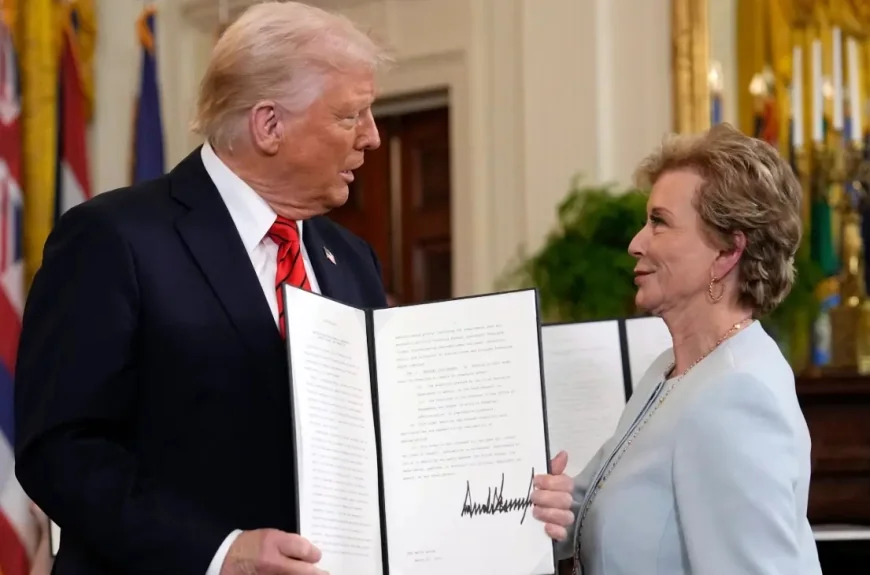
President Donald Trump shook up universities and school districts in 2025 using his executive power. Now comes the hard part: ensuring his policies endure beyond his presidency.
Trump signed numerous executive orders related to education—ranging from diversity initiatives to college oversight—launched a flurry of civil rights investigations into schools, withheld billions of dollars in federal research funding, and began fulfilling his long-held promise to dismantle the Department of Education.
His actions were intended to pressure schools into adopting policies that aligned with his political agenda, strengthen parental rights, and give states more control over their schools. In many ways, these steps succeeded: some schools responded by ending diversity programs, barring transgender students from women's sports, and striking unprecedented deals with the White House in the hope of having their federal research funding restored.
Trump's actions have left school leaders feeling uncertain about their relationship with Washington, just as conservatives have desired for decades. But many educators are fighting back in court, and Trump's reliance on executive action leaves a significant portion of his education legacy vulnerable to the next president's discretion. To make lasting changes, Trump's next step will be to make his policies difficult to undo.
"This has been the year of enforcement through investigation," said Bob Eitel, who served as a senior counsel to former Education Secretary Betsy DeVos and is now president of the Defense of Freedom Institute, a conservative think tank. "Next year will be the year of rulemaking."

Even with three years remaining in Trump's second term, he actually has little time to do so, as rulemaking is often a lengthy, detailed, and laborious process. It's the kind of work typically done by the career staff he spent months trying to remove from their jobs. This has led some former Education Department officials to doubt whether the administration will be able to fulfill its ambitious agenda of implementing Trump’s transgender student restrictions and investigating anti-Semitic sentiment on campuses, dismantling diversity programs, and overhauling college accreditation systems.
Education Secretary Linda McMahon has cut the agency’s staff in half. And the GOP’s One Big Beautiful Bill Act directed officials to finalize rules on several student loan policies within tight deadlines next year.
The Trump administration also faces midterm elections that could alter the composition of Congress, which is currently led by Republicans who generally support the president’s education agenda—even if they are wary of some of its specific elements. “The regulatory calendar can become so overloaded that it almost grinds to a halt,” said Ted Mitchell, who served as undersecretary of education in the Obama administration and is now president of the American Council on Education.
“That’s probably doubly true in a weakened Education Department, where there are fewer people to do the work,” he added. “I think we’re going to see a regulatory logjam that will take us through the midterms, and then the midterms will set the course for the next two years.”
Software Services
 |
Start your own gaming platform for just $3,000 |
White House spokeswoman Liz Houston said in a statement that the Education Department “has been failing American students, parents, and teachers for decades, and President Trump is making lasting changes to improve educational outcomes.”
Turning Trump’s Investigations into Policy
The flood of Trump investigations has been impossible to ignore, with administration officials unleashing the full force of the federal government in probes of schools across the country.
The Education Department, which did not respond to requests for comment for this story, has announced more than 120 investigations into higher education institutions and dozens into K-12 schools this year.
The scope of the pressure campaign has also expanded significantly. In addition to the Education Department’s Office for Civil Rights investigation, the General Services Administration and the Departments of Health and Human Services, Agriculture, Homeland Security, State, and Justice have all found ways to advance the president’s education agenda.
“The Trump administration has used civil rights tools with a confidence and zeal never before seen in a Republican administration,” said Kenneth Marcus, who previously led the Education Department’s Office for Civil Rights under both the Trump and George W. Bush administrations.
“The interagency action has been very real and has wielded far more power than before,” said Marcus, who now heads the Brandeis Center, a Jewish civil rights advocacy group.
In a stunning display of power, the Trump administration this year froze more than $5 billion in federal grants and contracts with universities, bringing some of the nation’s oldest and most prestigious institutions to their knees.
The Trump administration withheld more than $400 million in federal research grants and contracts from Columbia University, $175 million from the University of Pennsylvania, $510 million from Brown University, $1 billion from Cornell University, $760 million from Northwestern University, more than $2 billion from Harvard University, and $584 million from UCLA.
Software Services
|
Turn your casino idea into a live platform — start your journey today |
At the K-12 level, the administration withheld nearly $7 billion in previously approved federal education grants from schools until Republican lawmakers challenged the move, arguing it contradicted Trump’s promise to empower states to make decisions about their schools.
It also placed five school districts in Virginia on high-risk status and attempted to strip school lunch funding from Maine schools because of their transgender-inclusive policies.
K-12 schools and their states pushed back. All universities except Harvard and UCLA capitulated.
In exchange for their federal cash, several universities agreed to pay the federal government millions of dollars and change their policies regarding diversity programs, admissions, hiring, transgender students, and combating antisemitism.
Trump’s deals with these universities are set to be codified and expanded.
The department has already promised to issue regulations on the two federal laws that formed the basis of the investigations that led to these changes: Title IX, the federal education law that prohibits sex discrimination, and Title VI, the federal law that prohibits discrimination based on race and national origin.
Regulations amending how the Department of Education interprets these laws will strengthen the administration’s authority to demand these changes on campuses.
For example, the agency has already announced that it is enforcing Title IX based on biological sex, defining sex as male and female and barring transgender students from participating in women’s sports and using their facilities. It is also using the Trump administration's 2020 Title IX rule, which dictates how schools must handle reports of sexual harassment and assault, grants new rights to those accused of misconduct, and requires colleges to respond to formal complaints with court-like hearings.
But none of this is yet codified into regulation.
Ittel said the Trump administration needs to formally rescind a Biden-era rule that sought to codify protections for transgender students and improve upon the 2020 Trump rule, which has already been struck down by two courts. “Starting an investigation is one thing, whether it’s by one agency or multiple agencies in general,” Ittel said. “That’s important, but in the long run, what will matter is what rules are on the books and can be enforced going forward.”

Trump’s education actions face hurdles
Two federal judges sided with Harvard and UCLA — represented by its faculty union — and ordered the White House to restore their federal funding.
The law extended Pell Grants to short-term workforce training programs for the first time and established a federally funded program to promote school choice, allowing individuals to receive tax credits for donating to certain organizations that provide K-12 scholarships for education programs, including private schools.
It also changed the endowment tax for some schools, altered how borrowers repay their student loans, and placed limits on graduate student borrowing.
These policies now require the Department of Education to adopt regulations and begin working on implementation by July.
The Treasury Department must also begin crafting regulations on the school choice tax credit established in the law before it takes effect on January 1, 2027. But Trump administration officials still want to implement more regulatory changes on issues such as college foreign gift reporting requirements and to revisit accreditation in order to address what the administration considers ideological excesses.
“For any regulation, the sooner you start, the better,” Ittel said. “They have time to do this, but they need to be thoughtful and strategic in their approach.”
The Education Department is working quickly on the regulations to meet a July deadline mandated by law. But other department regulations could run afoul of the master calendar rule, a statutory deadline established by the Higher Education Act that dictates how much time institutions must be given to implement and prepare for significant new regulations.
Generally, regulations must be finalized by November 1 to take effect by July. If not, implementation of a regulation could be delayed by a year.
Legal deadlines and the department's regulatory calendar, coupled with staffing shortages at the agency, could create significant obstacles.
Read Also
 |
Key Points from Mamdani–Trump Meeting |
“I think it’s going to be a very slow crawl through a very difficult regulatory agenda,” Mitchell said.
If the Education Department proves unable to handle its regulatory responsibilities, it could undermine Trump’s argument that the agency is no longer necessary. The agency only recently, in December, decided to reinstate more than 260 employees in its Office for Civil Rights, which has been crucial to the administration’s enforcement efforts.
But Ittel and Marcus said they are confident in the agency’s ability to function effectively even with reduced staff, citing its successful launch of the FAFSA—the federal college financial aid form—and its strong track record of enforcing civil rights.
“It’s hard to remember that the Trump administration is still very early in its tenure,” Marcus said, adding that it has “really just begun.”
Thank you for reading this content.
Thank you for reading this content.
What's Your Reaction?
 Like
0
Like
0
 Dislike
0
Dislike
0
 Love
0
Love
0
 Funny
0
Funny
0
 Angry
0
Angry
0
 Sad
0
Sad
0
 Wow
0
Wow
0