






























After Weeks of Violence, Thailand and Cambodia Call Truce
Thailand and Cambodia declare an immediate ceasefire after weeks of deadly border clashes, allowing displaced civilians to return home safely.

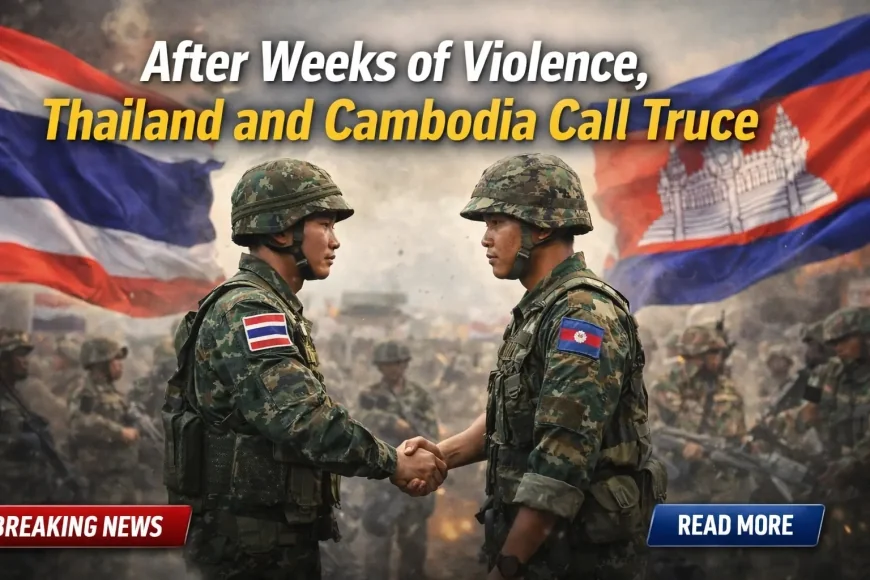
Thailand and Cambodia have agreed to an immediate ceasefire, the two countries' defense ministers said in a joint statement on Saturday.
Both sides agreed to halt all troop movements and allow civilians living in border areas to return home, ending weeks of fierce border clashes that killed at least 41 people and displaced nearly a million.
The ceasefire went into effect at 12:00 p.m. local time (05:00 GMT). The statement said that after the 72-hour ceasefire holds, 18 Cambodian soldiers captured by Thailand would also be released.
The breakthrough came after several days of talks between Thai and Cambodian officials aimed at ending renewed fighting between the two countries.
The joint statement outlines terms for "de-escalation," including "halting attacks on civilians, civilian targets and infrastructure, and military bases of both sides."
"Both sides should refrain from unprovoked firing or troop movements towards the other side's positions or troops," the statement said.

The statement also said the release of the 18 Cambodian soldiers captured by Thailand would be carried out in the spirit of the "Kuala Lumpur Declaration," an agreement signed between the two countries in October at a ceremony attended by U.S. President Donald Trump.
The ceasefire agreement had broken down earlier this month when new clashes erupted.
Since then, both sides have blamed each other for the ceasefire's collapse.
The Thai army said its troops responded to Cambodian shelling in Thailand's Si Sa Ket province, which injured two Thai soldiers. Cambodia's Defense Ministry said Thai forces launched the attack in Preah Vihear province, and insisted that Cambodia did not retaliate.
Clashes continued throughout December. On Friday, Thailand launched airstrikes on a disputed border area in Cambodia.
Software Services
 |
Turn your casino idea into a live platform — start your journey today |
The Thai Air Force said it attacked a Cambodian "fortified military base" after civilians had evacuated the area. Cambodia's Defense Ministry said the attacks were "indiscriminate attacks" on civilian homes.
The border dispute between Thailand and Cambodia is more than a century old, but tensions escalated in May of this year when a Cambodian soldier was killed in a clash.
Two months later, in July, fierce fighting erupted along the border for five days, killing dozens of soldiers and civilians. Thousands more civilians were displaced. Following intervention by Malaysia and US President Donald Trump, a fragile ceasefire was negotiated between the two countries and signed at the end of October.
Trump dubbed the agreement the "Kuala Lumpur Peace Agreement." It stipulated that both sides would withdraw their heavy weapons from the disputed area and establish an interim observer team to monitor the situation.
However, in November, Thailand suspended the agreement, with Thai Prime Minister Anutin Charnvirakul stating that the security threat "has not actually diminished."
Thank you for reading this content.
Thank you for reading this content.
What's Your Reaction?
 Like
0
Like
0
 Dislike
0
Dislike
0
 Love
0
Love
0
 Funny
0
Funny
0
 Angry
0
Angry
0
 Sad
0
Sad
0
 Wow
0
Wow
0