





























Under Pressure: Weston Wins Gold for Team GB
With 4 track records, Matt Weston clinched Olympic gold at the Winter Games, delivering Team GB’s first medal in a stunning skeleton triumph.

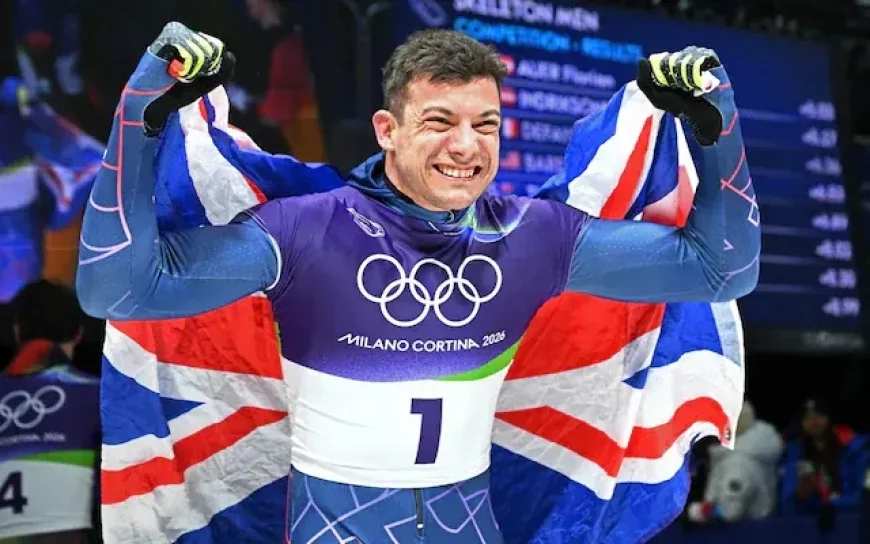
Standing at the top of the winding Cortina sliding track, his eyes set on Olympic gold, Matt Weston knew what he had to do.
After laying the foundation for skeleton gold on Thursday – correcting his first run mistakes to deliver a brilliant second run, breaking the track record each time – the British athlete needed more of the same performance on Friday.
What he delivered was not only a masterclass in sliding, but also a stunning display of patience and focus to win gold – Team GB's first medal of the Games – and cement his place at the top of the sport.
"This is everything. It means so much to me personally, I've worked so hard for this," Weston said.
"But everyone at home – my fiancée, my family, my friends, everyone who sacrificed everything for this. I've given up funerals, birthdays, everything for this moment. It feels great. I hope I made you all proud." Weston set a track record in all four of his runs and could have slowed down by a significant 0.39 seconds on his final attempt, but he accelerated further with a victory lap that lasted 55.61 seconds, finishing with an impressive overall time of 3:43.33.
It was a near-impossible task for the chasing teams, and Germany's Axel Jungk finished 0.88 seconds behind to win the silver medal, while his compatriot and defending Olympic champion Christopher Grotheer finished 1.07 seconds behind Weston to take the bronze.

The pressure was on. The 28-year-old from Redhill was considered a strong contender to top the podium in Italy, having dominated the sport over the past four years. However, no British athlete had previously won an Olympic skeleton gold medal.
He also carried the weight of Team GB, which was on the verge of complete disappointment at the Games, hoping for a record medal haul in Milan-Cortina, but saw those hopes dashed.
Weston ignored the uproar surrounding 'helmet-gate', seeing his teammate Vladislav Heraškevich disqualified from the competition moments before the first heat, and the troubles of Beijing 2022, where GB failed to win a skeleton medal for the first time since 2002.
He put all of this aside to add the Olympic crown to his two World Championship titles and three Crystal Globes – the overall World Cup trophy.
Four years ago, the story was different.
His immense disappointment at not reaching the Olympic podium almost forced him to quit the sport, and he revealed earlier this year that he had to teach himself to "love the pressure and expectations."
Software Services

From talking to friends and family to knowing when to rest and eating lots of pasta, Weston has discovered the secret to his success, and now he's reaping the benefits.
Weston 'handles the pressure' to fulfill his potential.
The new champion knows what it's like to return empty-handed from the Olympics, having finished 15th in his first Games in Beijing.
Knowing he doesn't want to experience that feeling again, he's worked on changing his mindset, and says that's what has paved the way for his success.
In 2023, he became Britain's first male world champion in 15 years, won a silver medal the following year, but will relinquish his title in 2025.
His first World Cup title came in 2024, and he's been unbeatable since. Earlier this year, he became the first man to defend the trophy twice – winning five of the seven races this season and finishing second in the other two.
Coming into these Games as the reigning World, European, and World Cup champion, he was under pressure to perform.
Read Also

"I've learned to love the pressure and the expectations placed on my shoulders," Weston told after his second run on Thursday.
"When I first had success, I didn't like it, but now I've turned it into a fire to go out and give it my best."
He represented England in taekwondo as a teenager, winning several medals at national level, but a back injury ended that distinguished sporting career.
He was also a talented rugby player, but like many skeleton racers, Weston discovered his love and ability for winter sports through a talent identification program nine years ago.
Moving up quickly in this sport has its issues, and after that disappointing result four years ago, Weston had to learn to embrace the pressure and, when winning became normal, the burden of being a favorite.
This attitude served him well in Italy, as he managed to block out the noise, citing the secret to his success as having fun.
Blocking out the off-track noise
Weston hasn't just blocked out the noise on the track.
During preparations for the Olympic events, there was heated debate in Italy about the British team's desire to wear a new helmet design.

He ultimately lost his appeal at the Court of Arbitration for Sport (CAS), resulting in a ban on wearing his new helmet.
Weston and teammate Marcus Wyatt, who were also expected to succeed but finished ninth, were confident it wouldn't matter, pointing to their victories throughout the season.
This came after Weston saw Ukraine's Heraskievich disqualified moments before the men's competition began on Thursday.
And after a week of no medals for the British team in Italy, the pressure on Weston gradually increased.
But he knew what he had to do to win gold, and he said he wouldn't settle for anything less in Cortina.
That doesn't always mean being the first to the track and the last to leave.
Instead of resting on Wednesday's final training run, he opted for mental relief by doing light stretching and talking to his fiancée about something other than sliding.
Also, eating lots of pasta, staying true to his motto "pasta makes you faster."

After all, skeleton training is demanding, especially for a British athlete.
There's no ice track in Britain—only the University of Bath has a push-start track—so a lot of time is spent in the gym working on speed and sheer strength to improve that crucial start.
A run on an ice track takes less than a minute, meaning British sliders spend around two and a half hours each year actually completing the run, spending a lot of time observing the track, understanding the twists and turns to ensure a smooth run.
But Weston has lived up to his tradition, and he's not only the first British man to win winter gold since Christopher Dean topped the ice dancing podium with Jayne Torvill in 1984, but also the first British man to win skeleton gold.
His success likely doesn't end there, as he'll partner Amelia Coltman in the newly introduced mixed team event for Milan-Cortina on Sunday.
Thank you for reading this content.
Thank you for reading this content.
What's Your Reaction?
 Like
0
Like
0
 Dislike
0
Dislike
0
 Love
0
Love
0
 Funny
0
Funny
0
 Angry
0
Angry
0
 Sad
0
Sad
0
 Wow
0
Wow
0